How To Break A Dog Of Demanding Attention
Written by George Walker Owner of Walkers K9 Services
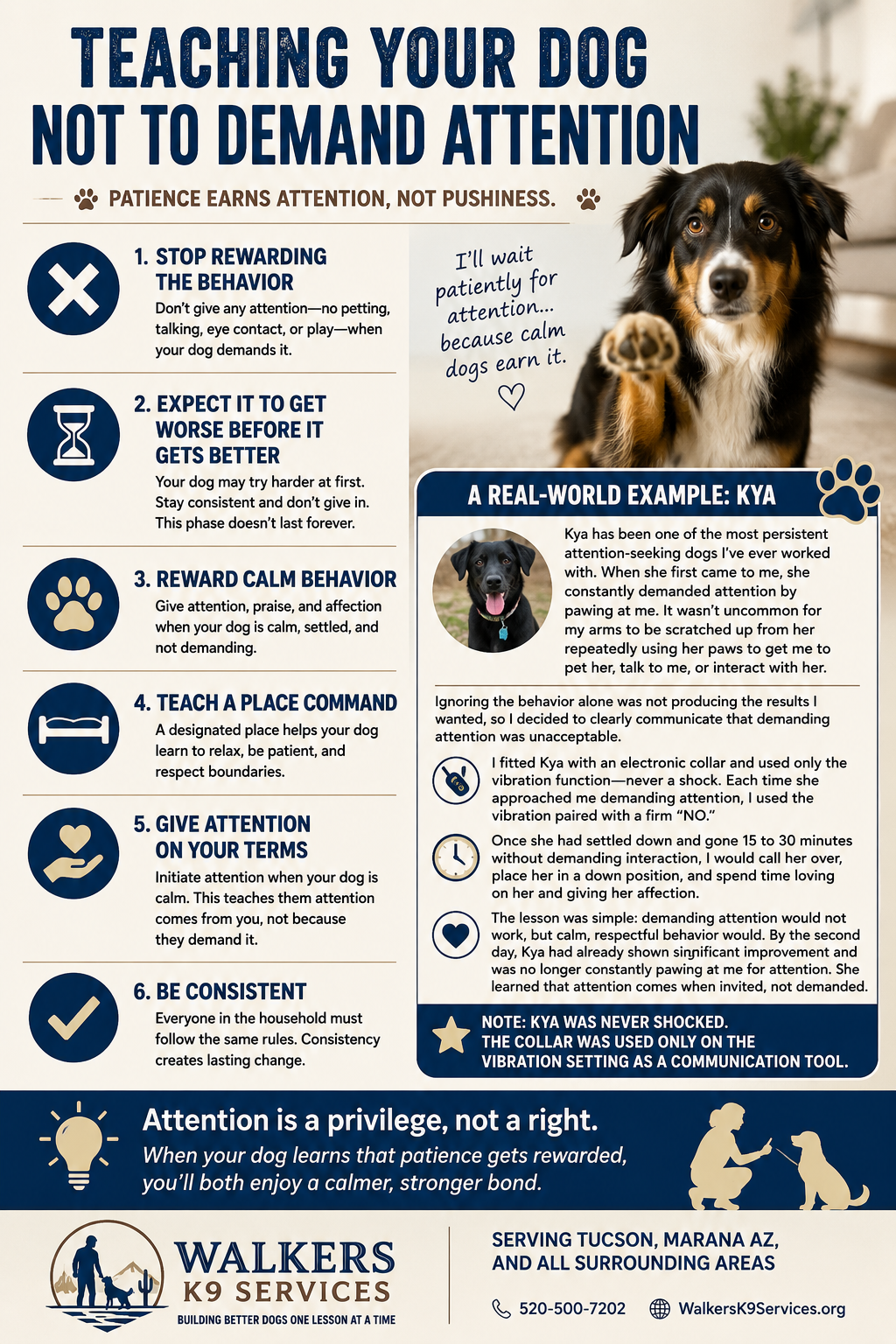
Many dog owners accidentally create attention-seeking behavior without even realizing it. A dog nudges your hand, paws at your leg, barks, whines, or drops a toy in your lap, and you respond by petting, talking to, or playing with them. From the dog's perspective, that behavior worked. The dog asked for attention and got it.
Over time, these behaviors can become frustrating. Some dogs become pushy, demanding, and even obsessive about getting attention whenever they want it. The good news is that teaching a dog to be patient and respectful is usually much easier than people think.
Why Dogs Demand Attention
Dogs repeat behaviors that are rewarded. If pawing at you gets petting, they will paw again. If barking gets you to throw a ball, they will bark more. If nudging your arm gets you to stop what you're doing and focus on them, they learn that nudging works.
The dog is not being stubborn or dominant. They are simply doing what has been successful in the past.
Stop Rewarding the Behavior
The first step is to stop paying attention to unwanted attention-seeking behaviors.
If your dog:
Paws at you
Nudges you
Barks at you
Whines for attention
Pushes a toy into your lap
Do not pet them, talk to them, or make eye contact. Simply ignore the behavior.
Many owners accidentally reinforce bad habits by saying things like:
"Stop it."
"Quit barking."
Even negative attention is still attention. To many dogs, any response is rewarding.
Expect the Behavior to Get Worse Before It Gets Better
One of the biggest mistakes owners make is giving in when the behavior intensifies.
Imagine a dog that normally paws at you twice before you pet them. If you suddenly ignore the behavior, the dog may paw harder, bark louder, or become more persistent.
This is normal.
The dog is essentially saying, "This always worked before. Let me try harder."
If you give in at that point, you have just taught the dog that persistence pays off. Stay consistent and wait for the unwanted behavior to stop.
Reward Calm Behavior
Ignoring unwanted behavior is only half the solution. You must also reward the behavior you want.
When your dog:
Lies quietly on the floor
Settles on their bed
Sits calmly nearby
Relaxes without demanding attention
That is the time to offer praise, petting, affection, or play.
The dog learns a valuable lesson:
Demanding attention doesn't work.
Being calm does.
Teach a Place Command
A Place command can be extremely helpful for dogs that constantly seek attention.
Send the dog to a designated bed, cot, or mat and require them to remain there until released.
This teaches:
Patience
Self-control
Relaxation
Respect for boundaries
Many dogs that struggle with demanding attention simply have never learned how to settle themselves.
Give Attention on Your Terms
One of the most important rules in dog training is this:
You should initiate attention more often than your dog.
Walk over and pet your dog when they are calm.
Invite them to play.
Call them over for affection.
This teaches the dog that attention comes from you, not because they demanded it.
Exercise and Structure Matter
Some attention-seeking behavior comes from boredom and excess energy.
Make sure your dog receives:
Daily exercise
Training sessions
Mental stimulation
Clear household rules
A tired dog is usually a calmer dog.
Consistency Is Everything
The biggest reason attention-seeking behavior continues is inconsistency.
If five family members ignore the behavior but one person gives in, the dog learns to keep trying.
Everyone in the household must follow the same rules.
A Real-World Example Of How To Break A Dog Of Demanding
Attention: Kya
Kya has been one of the most persistent attention-seeking dogs I have ever worked with. When she first came to me, she constantly demanded attention by pawing at me. It wasn’t uncommon for my arms to be scratched up from her repeatedly using her paws to get me to pet her, talk to her, or interact with her.
Ignoring the behavior alone was not producing the results I wanted, so I decided to clearly communicate that demanding attention was unacceptable. I fitted Kya with an electronic collar and used only the vibration function—never a shock. Each time she approached me demanding attention, I used the vibration paired with a firm “NO.”
Just as importantly, I made sure to show her what behavior would earn attention. Once she had settled down and gone 15 to 30 minutes without demanding interaction, I would call her over, place her in a down position, and spend time loving on her and giving her affection.
The lesson was simple: demanding attention would not work, but calm, respectful behavior would. By the second day, Kya had already shown significant improvement and was no longer constantly pawing at me for attention. She learned that attention comes when invited, not demanded.
It is important to note that Kya was never shocked during this process. The collar was used only on the vibration setting as a communication tool, combined with clear boundaries and rewarding the behavior I wanted to see.
As you can see in the below picture she has learned that laying down and relaxing is not such a bad thing. This is something she would never do before this lesson.
Final Thoughts
There is nothing wrong with giving your dog affection. In fact, affection is an important part of the relationship between dogs and their owners. The key is making sure attention is given when the dog is calm and respectful, not when they are demanding it.
When owners stop rewarding pushy behavior and start rewarding calm behavior, most dogs quickly learn that patience gets them far more attention than demanding it ever will.
A well-mannered dog understands that attention is a privilege, not something they can demand whenever they choose.