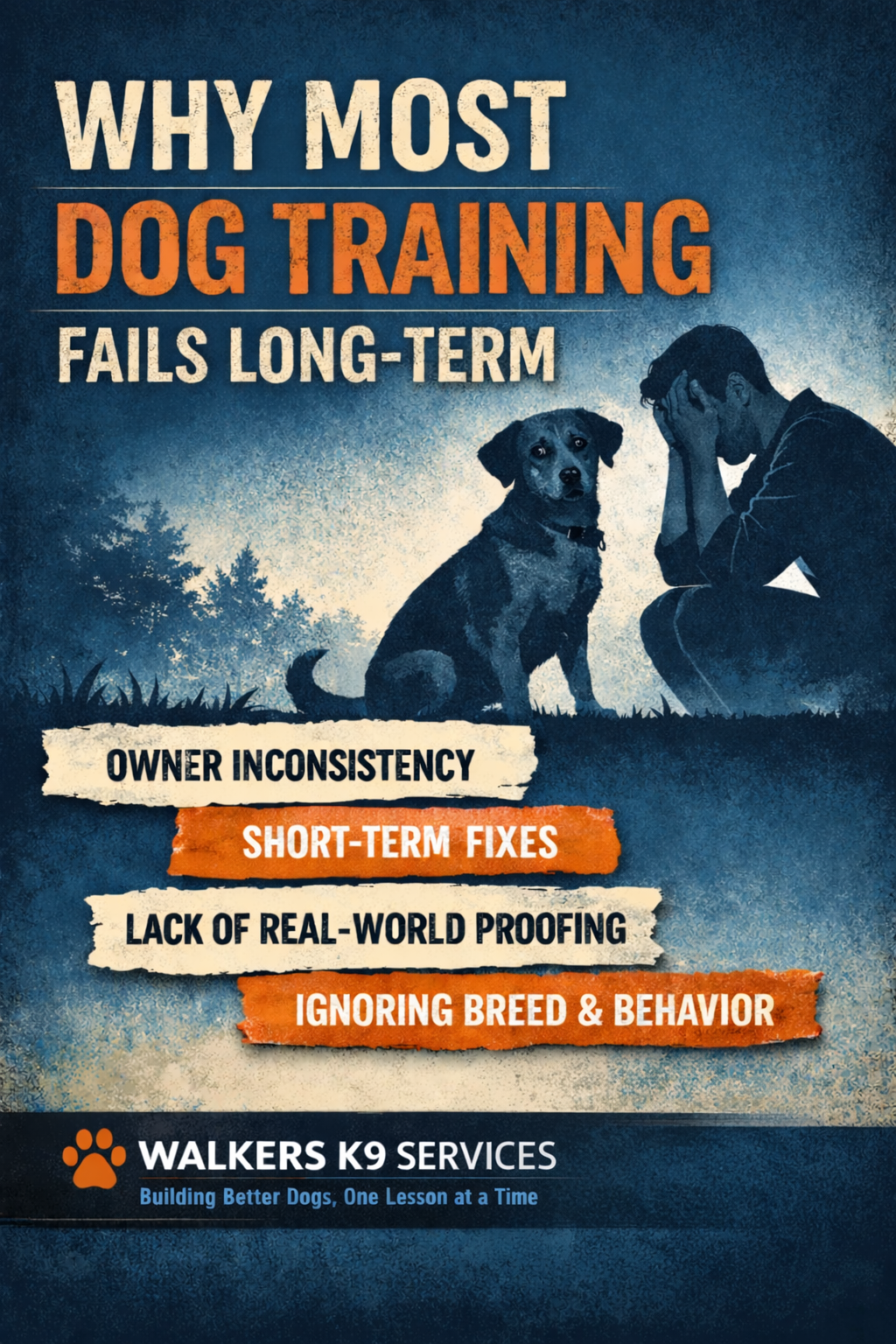
Why Most Dog Training Fails Long-Term
By George Walker, Walker’s K9 Services – Tucson, AZ
Dog training failure rarely looks like failure at first. In fact, most failed training programs begin with early success. The dog listens better. Behaviors improve. Owners feel hopeful. Everyone relaxes. And then—weeks or months later—the old problems return. Sometimes they come back worse. Sometimes they come back quietly, disguised as “stubbornness,” “selective hearing,” or “regression.”
The truth is uncomfortable but important:
Most dog training doesn’t fail because the dog didn’t learn.
It fails because the system around the dog didn’t change.
Training that doesn’t hold up long-term isn’t a dog problem. It’s a human, environmental, and
expectation problem. Let’s break down why this happens so often—and what actually
creates lasting results.
1. Training Focuses on Commands Instead of Behavior
One of the biggest reasons training fails is that many programs are built around commands, not
behavioral understanding.
A dog can:
Sit
Down
Come
Heel
…and still be anxious, reactive, pushy, fearful, or unsafe.
Commands are tools. They are not solutions.
Teaching a dog to “sit” doesn’t address:
Why the dog lunges at other dogs
Why the dog guards food or space
Why the dog ignores commands under stress
Why the dog shuts down or escalates
When training is reduced to a checklist of obedience behaviors, the root causes go untouched. The dog may comply in controlled settings, but real life doesn’t happen in training class environments.
Long-term success requires understanding:
Emotional state
Thresholds
Motivation
Stress responses
Reinforcement history
Without that, obedience becomes a fragile performance—one that collapses under pressure.
2. Owners Are Trained Less Than the Dog
This is the quiet killer of long-term results.
Many programs focus almost entirely on the dog:
The dog is trained
The dog is corrected
The dog is rewarded
The dog is evaluated
Meanwhile, the owner remains largely unchanged.
But dogs live with owners—not trainers.
If the owner:
Is inconsistent
Avoids confrontation
Gives mixed signals
Applies rules sometimes but not others
Changes expectations based on mood
Then training cannot hold.
Dogs thrive on clarity and consistency, not intentions or emotions. A dog trained perfectly by a professional will unravel quickly if the owner:
Doesn’t follow through
Feels guilty enforcing boundaries
Anthropomorphizes behavior
Negotiates rules
Long-term training success depends more on the owner’s behavior than the dog’s ability to learn.
3. Management Is Confused With Training
Another common failure point is confusing management with training.
Management tools include:
Crates
Gates
Leashes
Muzzles
Avoidance strategies
Environmental control
These tools are useful. Sometimes they are necessary. But they are not training.
If the dog only behaves because:
The leash is on
The gate is closed
The trigger is avoided
The situation never occurs
Then nothing has actually changed.
Eventually:
Someone forgets the gate
A leash slips
A guest ignores instructions
The dog is pushed past threshold
And the behavior returns.
Training should reduce reliance on management—not replace it entirely, but support it with behavioral change.
4. Emotional Comfort Is Prioritized Over Clarity
This is one of the most controversial points—and one of the most important.
Many owners are taught that:
Saying “no” is harmful
Corrections are mean
Firm tone damages trust
Boundaries suppress personality
This leads to hesitation, uncertainty, and inconsistency.
Dogs do not experience clarity as cruelty.
In dog-to-dog communication:
Growls are normal
Corrections are normal
Escalation happens when signals are ignored
Clear communication is not emotional. It is information.
When owners avoid giving clear feedback, dogs are left guessing. Guessing creates anxiety. Anxiety creates behavior problems.
Long-term training fails when dogs live in gray areas instead of clear expectations.
5. Training Happens in Artificial Environments
Another major problem is that training often happens:
In quiet rooms
In controlled classes
With predictable routines
Without real-world distractions
Then owners expect those results to magically transfer to:
Busy neighborhoods
Dog parks
Guests at the house
Kids running
Wildlife
Stressful environments
Dogs don’t generalize well without guidance.
A behavior learned in one context does not automatically apply to others. Long-term success requires proofing behaviors across environments, distractions, and emotional states.
When training stops at “the dog does it in class,” failure is already built in.
6. Expectations Are Unrealistic or Unspoken
Many owners unknowingly sabotage training by holding conflicting expectations.
Examples:
Wanting a protective dog that’s also universally friendly
Wanting independence without disobedience
Wanting energy without chaos
Wanting affection without boundaries
Dogs cannot meet expectations that are:
Contradictory
Unclear
Constantly changing
If expectations aren’t clearly defined and consistently reinforced, the dog will default to what works for them.
Training fails long-term when owners don’t decide:
What behaviors are acceptable
What behaviors are not
What rules are permanent
What rules are situational
Dogs do not thrive in ambiguity.
7. Short-Term Fixes Are Marketed as Solutions
The dog training industry rewards fast results.
Quick fixes sell:
“Stop barking in 5 minutes”
“Fix reactivity instantly”
“No corrections ever”
“Guaranteed results”
Real behavior change takes time, repetition, and accountability.
When owners expect:
Permanent change without maintenance
Behavior modification without effort
Results without lifestyle adjustments
Training becomes temporary by design.
Long-term success is not flashy. It’s quiet. It’s boring. It’s consistent. And it doesn’t make for viral marketing.
8. The Dog’s Genetics and Purpose Are Ignored
Not all dogs are blank slates.
Breed traits matter:
Drive
Energy
Reactivity
Guarding instincts
Independence
When training ignores what a dog was bred to do, expectations become unrealistic.
You cannot train:
High drive out of a working dog
Independence out of a guardian breed
Sensitivity out of a herding dog
You can channel, manage, and guide these traits—but not erase them.
Training fails long-term when dogs are expected to behave like something they’re not.
What Actually Creates Long-Term Success
Training holds when:
Owners change with the dog
Rules are clear and enforced
Behavior is addressed, not just obedience
Training extends into real life
Emotional states are considered
Communication is honest and consistent
Expectations match the dog in front of you
Long-term training success is not about being harsh or soft. It’s about being clear, fair, and consistent.
Final Thoughts
Most dog training fails long-term not because dogs are stubborn, dominant, or untrainable—but because training stops too early, focuses on the wrong things, or avoids uncomfortable truths.
Dogs don’t need perfection.
They need leadership.
They need clarity.
They need consistency.
When those things are present, training doesn’t just “work.” IT LAST
Dog Training in Tucson, AZ Dog Training in Marana, AZ Training Options
Walkers K9 Services — Building Better Dogs, One Lesson at a Time 🔹
Please support our mission by sharing our training articles with other dog owners.
Written by: George Walker
Walkers K9 Services | Tucson & Marana, AZ
📞 520-500-7202