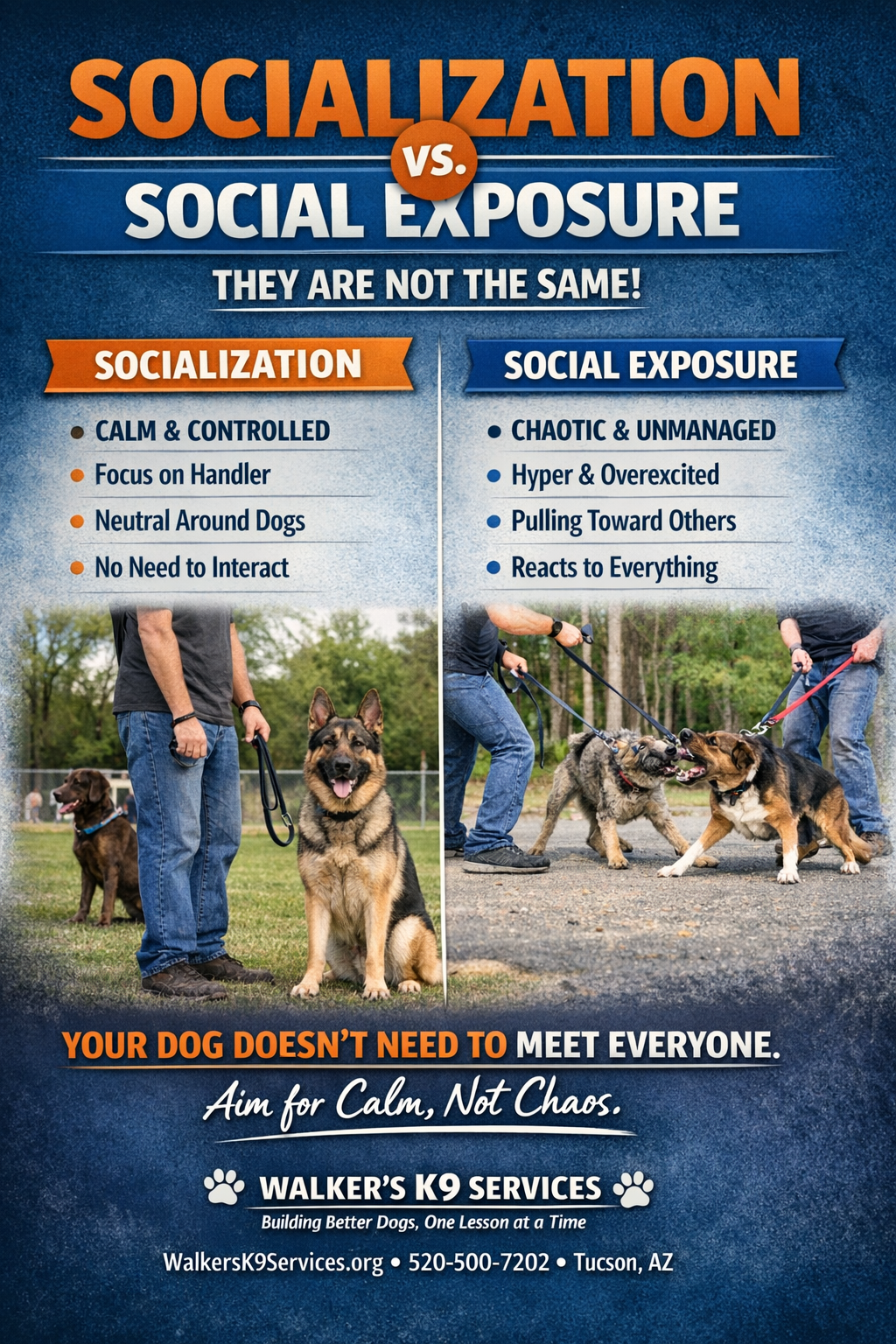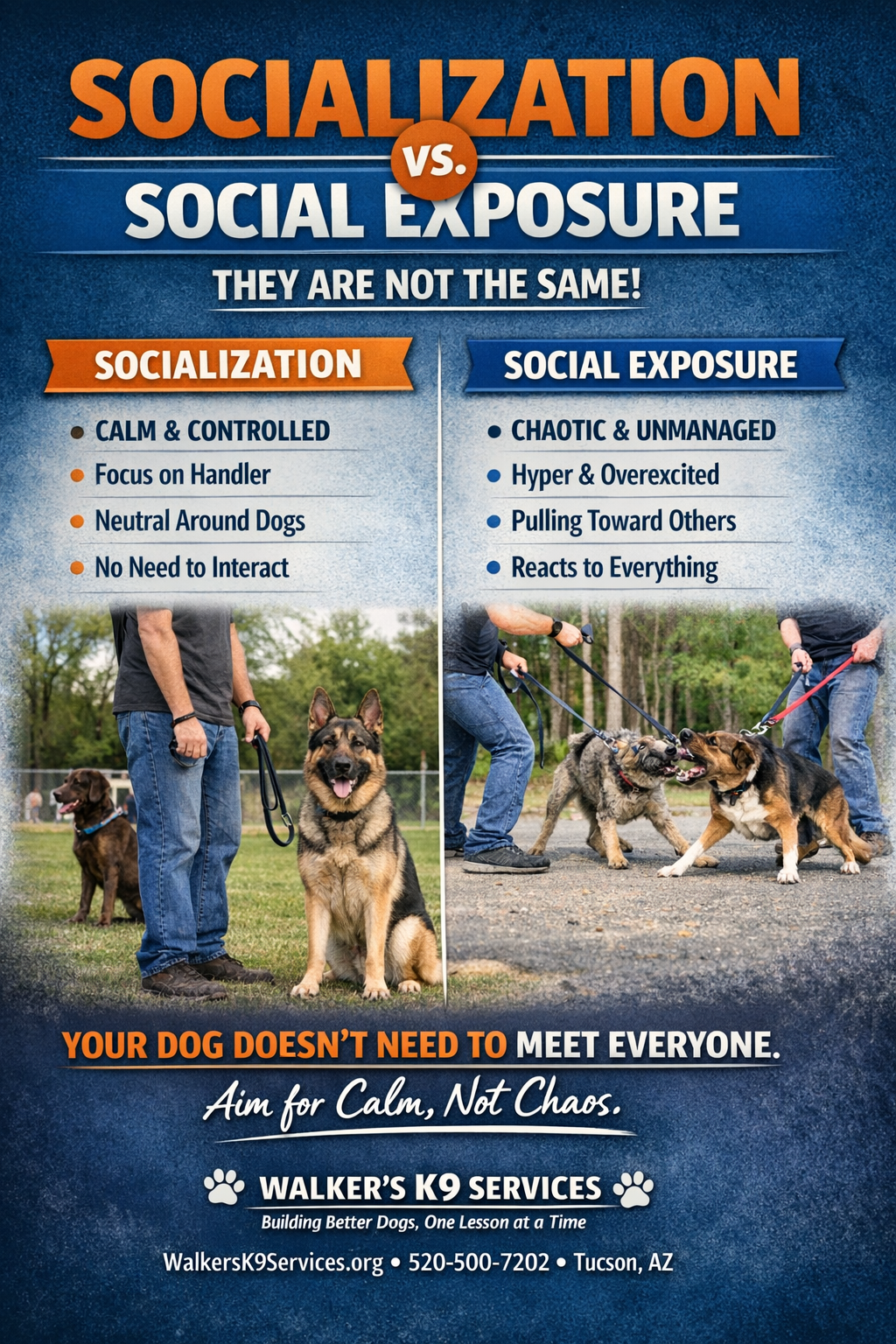
Socialization vs. Social Exposure: Why They Are NOT the Same
By George Walker, Walker’s K9 Services – Tucson, AZ
Few topics in dog training are more misunderstood—and more damaging when done incorrectly—than socialization. Most dog owners believe they are “socializing” their dog when in reality, they are doing something very different: social exposure.
The problem?
Social exposure without structure creates more behavior problems than it prevents.
This confusion is one of the leading reasons dogs develop reactivity, anxiety, fear-based aggression, and poor impulse control. Understanding the difference between these two concepts can mean the difference between a calm, confident dog and one that struggles in public for life.
This article breaks down:
What socialization actually is
What social exposure really does
Why most dogs are over-socialized and under-trained
How to socialize properly at any age
Why forcing interactions often backfires
What Most People Think Socialization Is
Ask ten dog owners what socialization means, and most will say something like:
“Letting my dog meet lots of people and dogs.”
That belief has been reinforced by:
Puppy class marketing
Social media dog culture
Dog parks
Well-meaning but unqualified advice
Unfortunately, this definition is incomplete and often harmful.
Allowing a dog to interact with everything it sees does not teach calm behavior.
It teaches expectation. And when expectations aren’t met, frustration follows.
What Socialization REALLY Means
True socialization is not interaction.
It is neutral exposure paired with emotional stability.
Socialization means teaching a dog:
The world exists
Stimuli do not require reaction
Calm behavior is expected
Focus remains on the handler
A well-socialized dog does not feel the need to greet every dog, person, bicycle, or noise. Instead, the dog learns:
“I notice it — and I move on.”
That neutrality is the goal.
What Social Exposure Is
Social exposure is simply placing a dog near stimuli.
Examples:
Walking through a crowded park
Seeing other dogs on leash
Hearing traffic, construction, or crowds
Observing children, carts, bikes, and noises
Social exposure is necessary, but by itself it does nothing to teach the dog how to behave.
Without guidance, exposure becomes overwhelming.
Why Exposure Alone Fails
When dogs are repeatedly exposed without structure, several things can happen:
1. Overstimulation
Dogs become flooded with sights, sounds, and smells without direction. Learning shuts down.
2. Frustration
Dogs learn they want interaction but don’t always get it. This builds leash reactivity.
3. Fear Conditioning
A single bad experience during uncontrolled exposure can permanently shape behavior.
4. Dependency
Dogs become reliant on constant engagement instead of self-regulation.
The Dog Park Problem
Dog parks are one of the clearest examples of mistaken socialization.
Dogs at parks are:
Unscreened
Untrained
Unbalanced
Over-aroused
When dogs learn that:
Every dog equals play
Rough behavior goes unchecked
Humans do not intervene
They develop habits that don’t translate to real-world obedience.
Many reactive dogs started as “friendly” puppies who were overexposed without structure.
Socialization Is About Emotional Control
The core of socialization is not friendliness.
It is emotional stability.
A properly socialized dog can:
Walk past dogs without reacting
Ignore strangers unless invited
Remain calm in crowds
Recover quickly from surprise stimuli
That dog may be friendly—but friendliness is optional. Stability is not.
Puppies vs. Adult Dogs
Puppies
Puppies are impressionable, but also vulnerable.
Poor puppy socialization often includes:
Forced greetings
Excessive handling
Overcrowded puppy classes
Too much freedom too soon
Puppies need:
Controlled exposure
Short sessions
Calm environments
Positive but neutral experiences
Adult Dogs
Adult dogs can absolutely be socialized—but the process is slower and more deliberate.
For adult dogs:
Neutral exposure comes before interaction
Structure precedes freedom
Trust must be rebuilt
Expectations must be clear
Socialization is not age-limited—it is process-limited.
Why Forced Interaction Is Dangerous
When a dog is pushed into interaction:
Fear signals are ignored
Stress compounds
Fight-or-flight responses escalate
Many bites happen when humans say:
“He’ll get used to it.”
Dogs don’t “get used to” stress—they store it.
A calm dog is not created by exposure to chaos.
The Role of the Handler
Socialization does not happen accidentally.
It happens through:
Leash control
Spatial awareness
Timing
Calm leadership
Dogs look to humans for direction. When humans fail to provide it, dogs make decisions themselves—and those decisions are often reactive.
Neutrality Is the Gold Standard
A socially stable dog:
Observes without fixation
Remains responsive to commands
Shows relaxed body language
Does not demand interaction
This is what professional trainers aim for.
Not excitement.
Not friendliness.
Neutral calmness.
Common Myths That Cause Problems
“My dog just wants to say hi”
That’s not a reason—it’s a lack of training.
“He needs to get his energy out”
Energy should be managed through structure, not chaos.
“She’s friendly”
Friendly dogs can still be reactive.
“Socialization fixes behavior issues”
Poor socialization often creates them.
How to Properly Socialize a Dog
Start at a distance
Reward calm observation
Keep sessions short
End before overstimulation
Gradually reduce distance
Introduce interaction only when calm
Advocate for your dog
Socialization is not rushed.
Why Many Trainers Avoid the Term “Socialization”
Because the word has been misused to justify:
Lack of boundaries
Poor impulse control
Unsafe interactions
Many professionals now use terms like:
Neutral exposure
Environmental conditioning
Behavioral stability
Because words matter—and expectations matter more.
Final Thoughts
Socialization does not mean your dog needs to meet everyone.
It means your dog needs to exist calmly in the world.
When you shift your goal from interaction to stability, everything changes:
Walks become peaceful
Reactivity decreases
Confidence increases
Trust deepens
The calm dog is not created by more excitement—but by better leadership.
Dog Training in Tucson, AZ Dog Training in Marana, AZ Training Options
🐾 Follow Us For Daily Training Tips 🐾
Walkers K9 Services — Building Better Dogs, One Lesson at a Time
Please support our mission by sharing our training articles with other dog owners.
Written by: George Walker
Walkers K9 Services | Tucson, Marana AZ and All Surrounding Areas
520-500-7202
www.WalkersK9Services.org