REHOMING
Written By George Walker - Walkers K9 Services
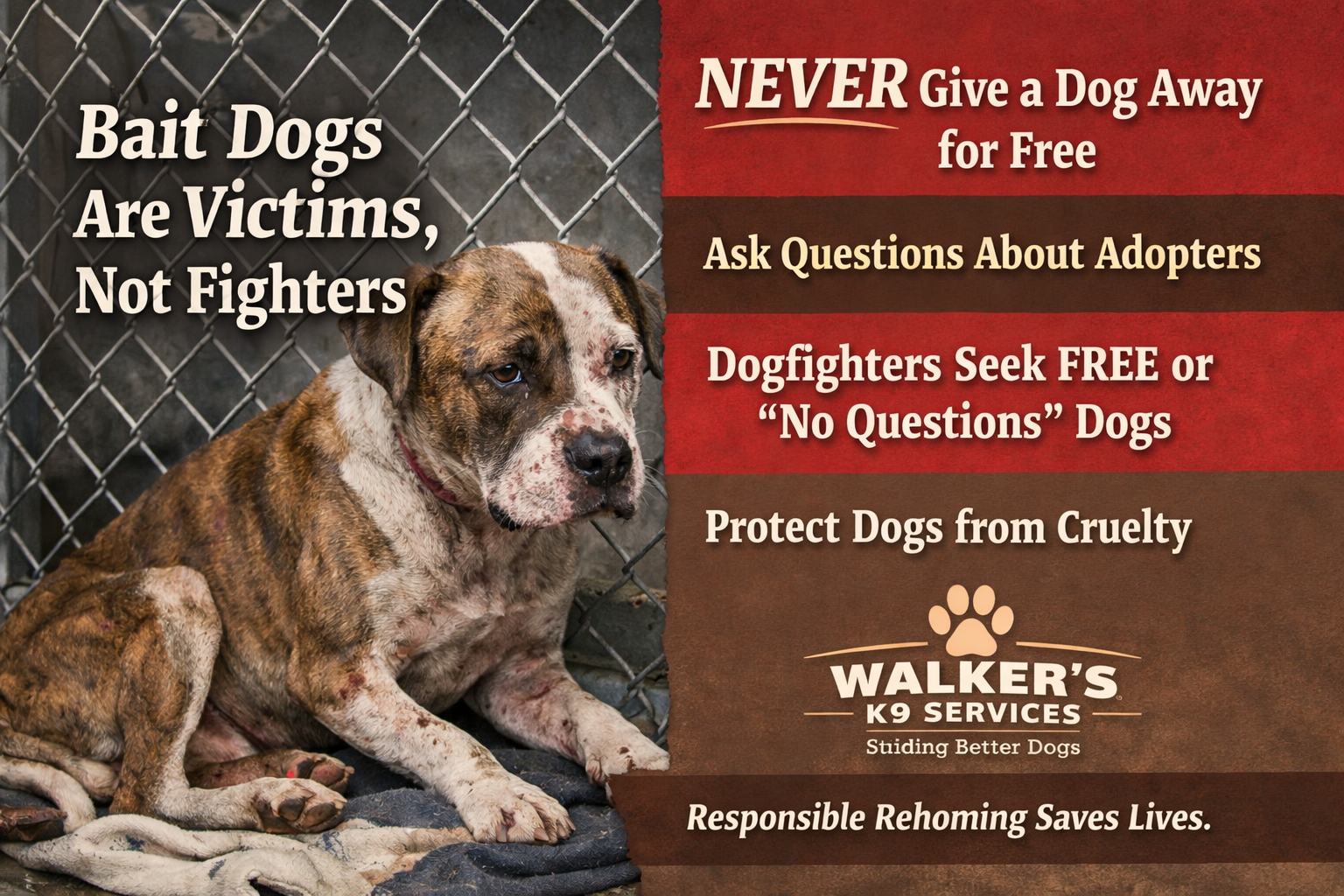
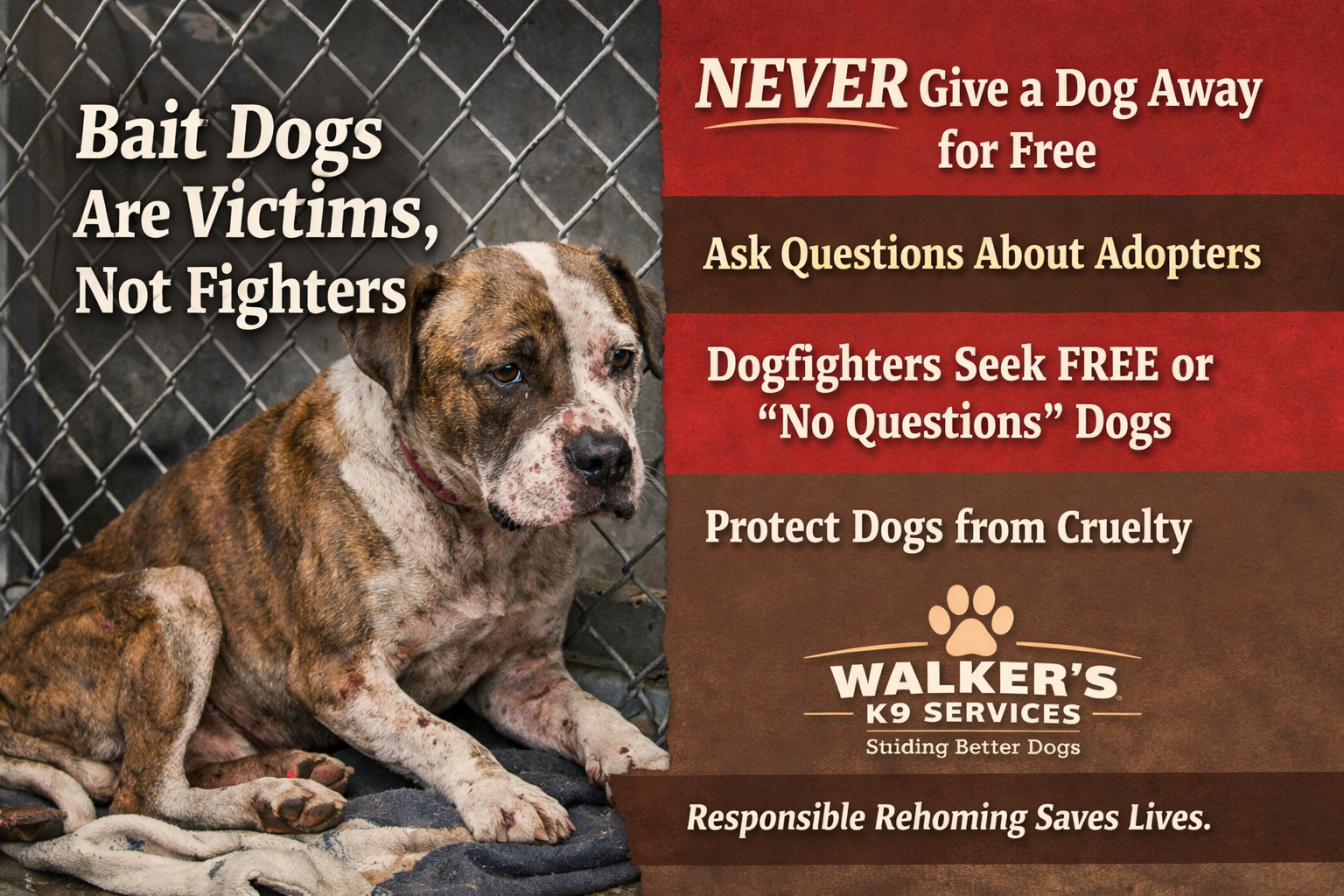
Why You Should NEVER Give a Dog Away for Free
One of the most important—and uncomfortable—truths about bait dogs is
how easily they are acquired.
Dogs given away for free are at significantly higher risk of abuse.
People involved in dogfighting actively look for:
Free dogs
Unneutered dogs
Dogs with no paperwork
Dogs whose owners ask few or no questions
A smiling stranger and a quick story do not equal a safe home.
Giving a dog away without proper screening can unintentionally place
that dog into a life of unimaginable suffering.
Responsible Rehoming Saves Lives
If you must rehome a dog, responsible steps include:
Charging a rehoming fee
Asking detailed questions about the adopter’s experience
Verifying veterinary and personal references
Conducting meet-and-greets
Ensuring the dog will be spayed or neutered
Trusting your instincts—if something feels off, walk away
A responsible adopter will understand and respect these precautions.
Anyone who pressures you not to ask questions is a red flag.
Here’s what we know from available data and estimates about dogfighting in the United States over the past decade (2015–2025). Because dogfighting is illegal and highly secretive, precise nationwide statistics (like annual dogfights or exact arrests) aren’t fully tracked by a central source, but credible estimates and documented figures provide a picture of the scope and trends:
📊 Estimated Scope of Dogfighting Activity
Estimated people involved: Some organizations estimate that around 40,000 Americans are involved in dogfighting activities annually, including breeders, handlers, organizers, spectators, and bettors.
Estimated dog deaths: Based on some advocacy sources, as many as 16,000 dogs may die each year in the dogfighting industry in the U.S. due to fights and related abuse.
Note: This figure is a widely cited estimate but not an exact scientific count, as many cases go unreported or undetected.
📍 Reporting, Enforcement & Rescues
Dogfighting is illegal in all 50 states, and being a spectator or owning a dog for fighting purposes is criminalized nationwide.
Law enforcement and animal welfare groups continue to raid and rescue dogs from illegal operations. For example, in one recent period, the ASPCA assisted with nearly 350 dogfighting victims through multiple rescues across states like South Carolina and Pennsylvania.
High-profile enforcement actions still occur:
In Georgia, a defendant was sentenced to 475 years in prison after being convicted on 93 dogfighting counts and other cruelty charges, with over 100 dogs found in appalling conditions.
Federal prosecutions include cases where 190 dogs were seized from a large-scale dogfighting operation in Oklahoma.
📉 Trends and Challenges
Because dogfighting is hidden and often underreported, official criminal justice figures for total arrests and convictions are incomplete.
Advocacy organizations highlight that many cases go undetected until law enforcement receives a tip or raids a suspected location.
Enforcement partnerships between animal welfare groups and police have increased over the past decade, leading to more seizures and prosecutions—but experts say the practice persists underground.
🧠 What This Means
Because national dogfighting data isn’t systematically collected like some other crimes, statistics are best understood as estimates and trends rather than exact counts. The key takeaways from organizations tracking this issue are:
Dogfighting remains a persistent and hidden form of animal cruelty, despite being a felony nationwide.
Thousands of dogs may be harmed or killed annually in connection with dogfighting operations in the U.S.
Law enforcement and animal welfare partnerships have grown, leading to significant rescues and criminal convictions.
🚨 IMPORTANT NOTICE 🚨
The remainder of this article contains graphic descriptions of animal cruelty.
This content may be upsetting to some readers.
Please proceed only if you are comfortable reading about these realities.
The Tragic Reality of Bait Dogs
The term “bait dog” refers to a dog used in illegal dogfighting operations to train, test, or condition fighting dogs. These dogs are not fighters—they are victims. What happens to bait dogs is among the most tragic and heartbreaking forms of animal cruelty, and it often goes unseen by the public.
Understanding their suffering is the first step toward stopping it.
What Is a Bait Dog?
Bait dogs are typically dogs that are perceived as weak, submissive, or unlikely to fight back. They are used to provoke aggression and build confidence in fighting dogs. Many bait dogs are stolen pets, shelter dogs, or strays taken advantage of by cruel individuals.
These dogs are not trained to fight. They are used to be attacked.
The Physical Trauma Bait Dogs Endure
Bait dogs frequently suffer devastating injuries, including:
Severe bite wounds to the face, neck, legs, and abdomen
Torn ears, lips, and eyelids
Broken bones and crushed tissue
Untreated infections and abscesses
Permanent scarring and disfigurement
Often, bait dogs receive no veterinary care. Their injuries are left to worsen, causing extreme pain, infection, and long-term damage.
Some do not survive.
The Psychological Damage Is Often Worse
While the physical wounds are horrific, the emotional trauma can be lifelong.
Many rescued bait dogs show signs of:
Extreme fear of other dogs
Shutdown behavior or learned helplessness
Panic responses to loud noises or sudden movements
Severe anxiety and hypervigilance
Fear of people, leashes, or confinement
These dogs learn that pain is unavoidable and that submission does not guarantee safety. Rebuilding trust can take months—or years.
Why Bait Dogs Rarely Fight Back
A common misconception is that a dog must be aggressive to be involved in dogfighting. In reality, bait dogs are often chosen because they are not aggressive.
They may be:
Gentle
Social
Young
Injured
Elderly
Many bait dogs never defend themselves. Some don’t even attempt to escape. Their passivity makes the abuse even more tragic.
Rescue Is Only the Beginning
When bait dogs are rescued—often during law enforcement raids—the road to recovery is long and uncertain.
They may require:
Extensive medical treatment
Behavioral rehabilitation
Slow, carefully structured socialization
Patient, experienced handlers or foster homes
Some bait dogs go on to live full, happy lives. Others may always carry emotional scars. Every success story, however, is a testament to their resilience.
How Dog Owners and Communities Can Help
Stopping the abuse of bait dogs requires awareness and action.
You can help by:
Reporting suspected dogfighting activity
Securing your pets and not leaving dogs unattended outdoors
Supporting animal cruelty investigations
Educating others about the signs of dogfighting
Supporting rescues and shelters that rehabilitate abused dogs
Dogfighting thrives in secrecy. Awareness saves lives.
A Final Thought
Bait dogs are not broken.
They are not weak.
They are not disposable.
They are victims of extreme cruelty—and when given safety, structure, and compassion, many show an incredible capacity to heal.
They deserve protection, justice, and a voice.
Dog Training in Tucson, AZ Dog Training in Marana, AZ Training Options
Walkers K9 Services — Building Better Dogs, One Lesson at a Time 🔹
Please support our mission by sharing our training articles with other dog owners.
Written by: George Walker
Walkers K9 Services | Tucson, AZ
📞 520-500-7202