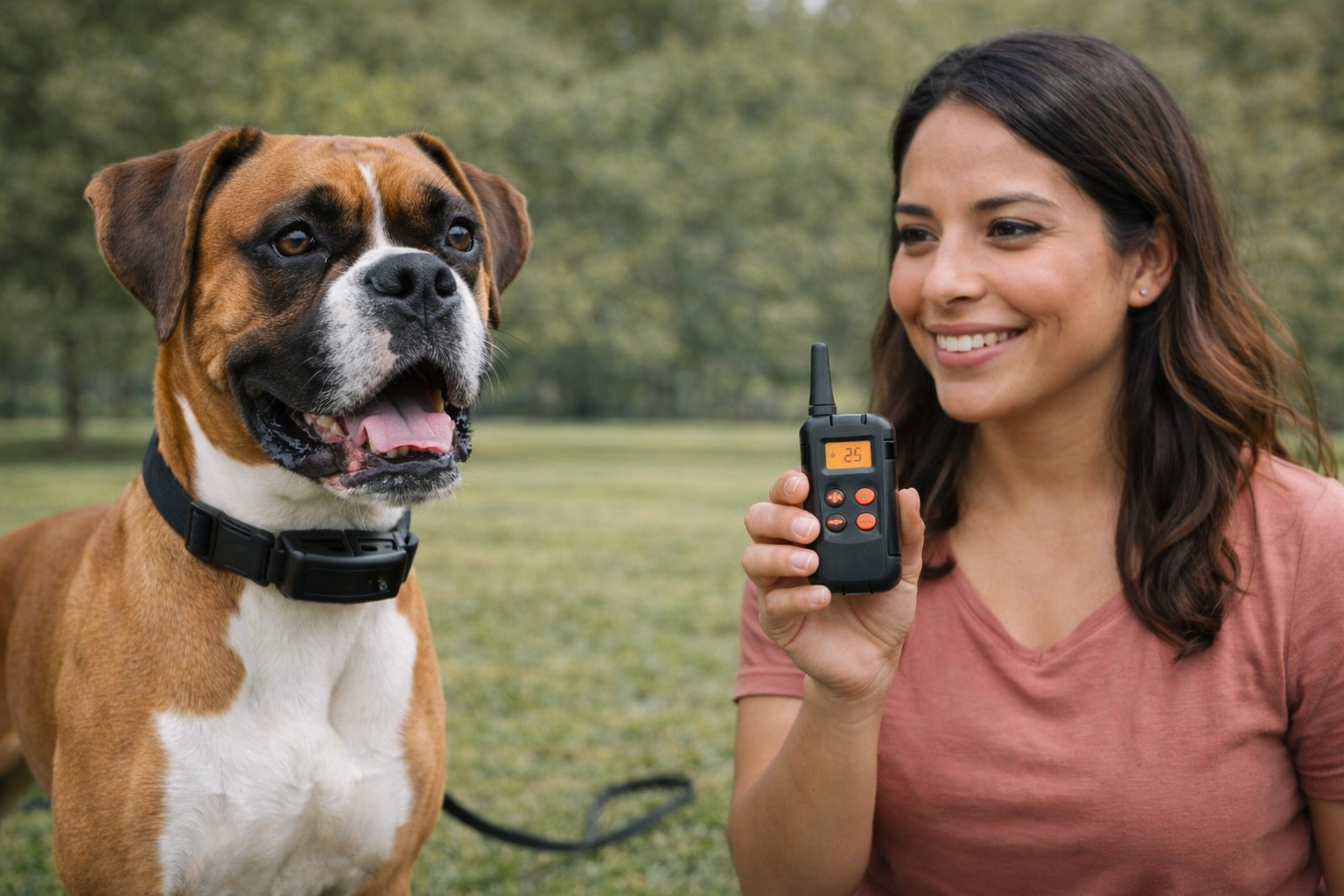
Properly Introducing Your Dog to an E-Collar
When people hear “E-collar,” they usually picture something harsh or intimidating. But here’s the truth your dog needs you to understand: an E-collar is not a punishment tool. It’s a communication device. And if you introduce it the right way, your dog will understand it the same way they understand a tap on the shoulder or a light nudge to get their attention.
A properly conditioned E-collar actually reduces stress, improves clarity, and builds confidence—because your dog finally has a clear, consistent signal that means the same thing every time, no matter where you are.
Let’s walk through how to introduce it the right way so your dog learns with you, not in spite of you.
Step 1: Fit the Collar Correctly
Most people slap an E-collar on loosely and wonder why it doesn’t work. Contact points have to touch the skin.
Here’s the rule of thumb:
Snug, not tight
Doesn’t spin freelyContact points sit high on the neck (think 10–2 o’clock)
If the collar slides or rotates, your dog gets inconsistent stimulation—and inconsistent communication = frustration.
Step 2: Find the Working Level
This is the most important part.
Every dog has a unique “working level”—the lowest level where they notice the sensation but don’t react to it.
It’s not supposed to startle, sting, or cause any dramatic behavior. Ideally, you see something subtle:
A head turn
An ear twitch
A dog pausing momentarily
That’s your working level. That’s where training begins.
Never start high. Never guess. Build trust by helping your dog understand that this sensation is just information.
Step 3: Pair It With Existing Commands
Your dog should already know the foundation commands before you ever pick up an E-collar. When you introduce the collar, you’re not teaching new commands—you’re reinforcing the ones they already know.
You’re basically saying:
“Hey buddy, this little tap means the same thing as my voice or leash cue.”
Start simple: sit, come, place, heel.
Tap → Command → Reward.
Tap → Command → Reward.
You’re creating an association: the small stimulation means “listen and follow through.” Reward for compliance so the dog sees the whole process as a win.
Step 4: Add Movement
Most dogs understand things better when they’re in motion. This is where E-collar clarity really clicks.
Use low-level stimulation during:
Slow heeling
Changing directions
Recall
Moving to a place cot
You’re not correcting—you’re guiding. Think of the stimulation as a leash you can “feel” at 100 yards away.
Step 5: Proof It in Real Life
Once your dog is responding beautifully in low distraction areas, start gradually stepping up the environment:
The backyard
The driveway
A quiet park
A busier area
Increase distractions slowly. The E-collar becomes your insurance policy: your dog can hear you even when their brain is pulled in a hundred directions.
This is where freedom comes from.
This is why E-collars change lives.
Step 6: Only Increase Levels When Necessary
There are moments where higher levels are appropriate, usually for high distraction or safety-critical situations.
But that shouldn’t be the norm.
You go up only when:
The dog fully understands the command
The distraction level is high
The situation requires a stronger interrupt
And you always bring the level back down once the distraction fades. Smart, fair, consistent.
Final Thoughts
When introduced correctly, the E-collar isn’t about punishment. It’s about communication, consistency, and freedom. It gives your dog a clear language to follow, no matter the distance, distraction, or chaos around them.
And at the end of the day, a dog who understands the rules is a dog who feels safe, confident, and calm.
Dog Training in Tucson, AZ Dog Training in Marana, AZ Training Options
Please help us by sharing our training articles
Written by: George Walker
Walkers K9 Services – Tucson, AZ
520-500-7202