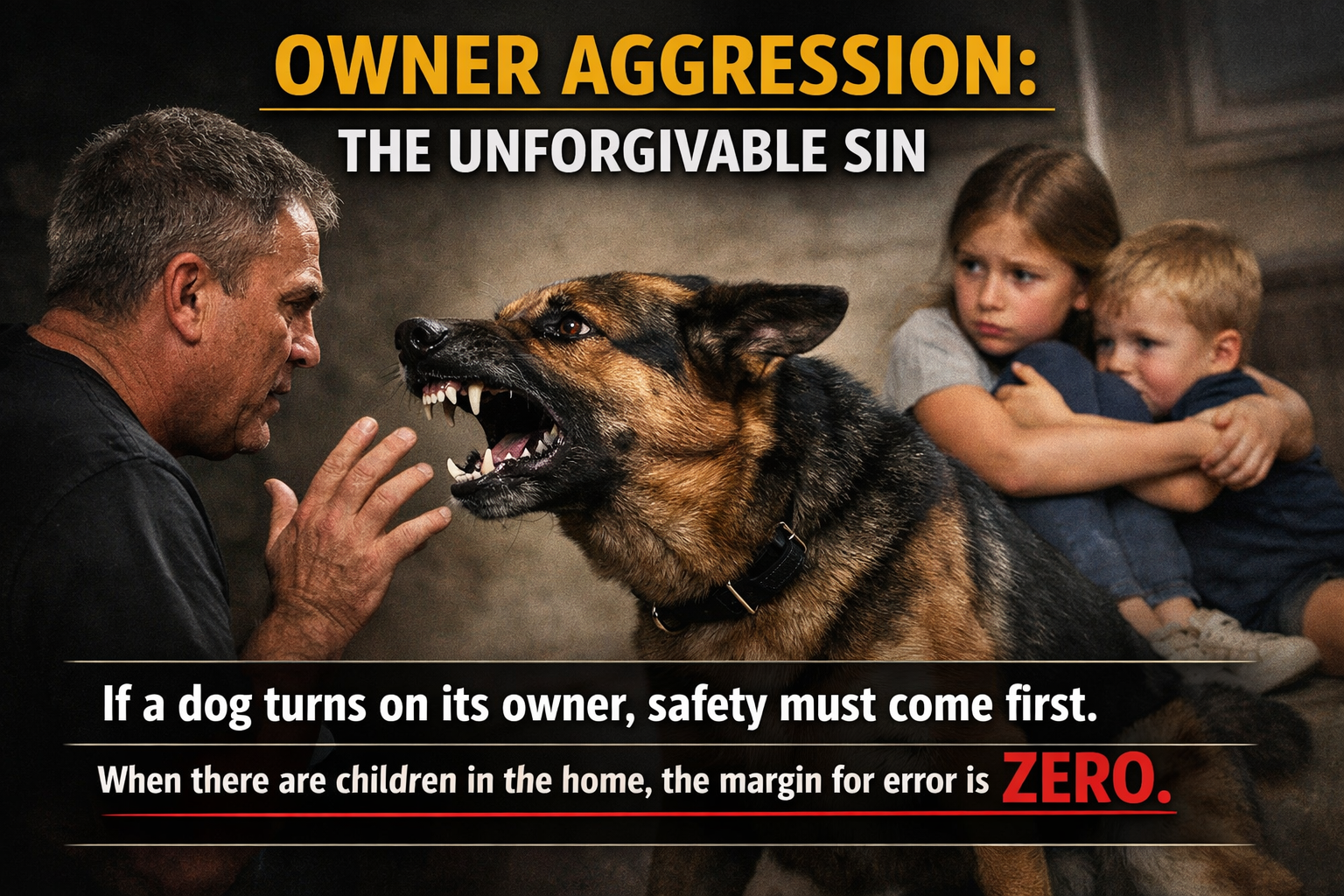
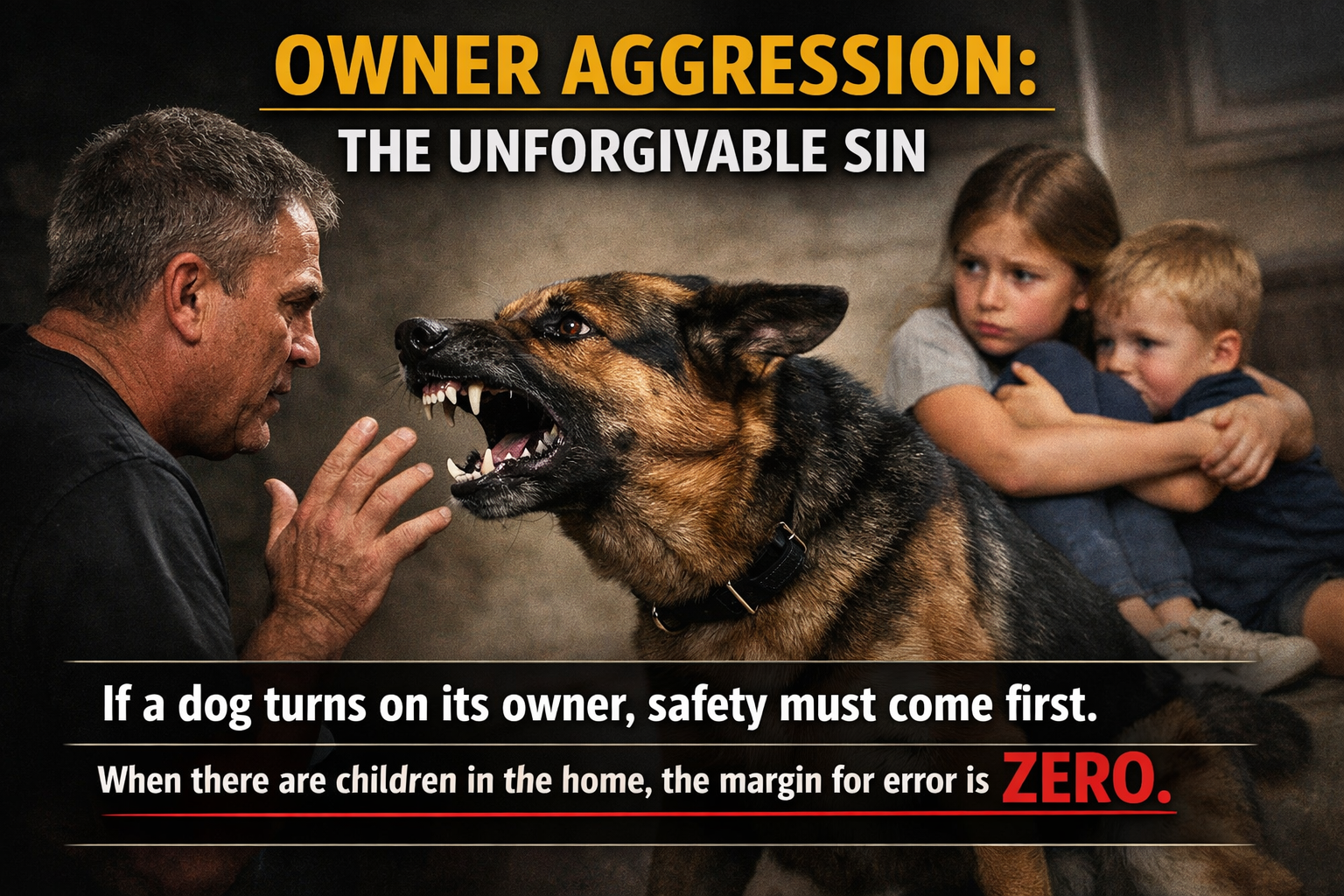
Owner Aggression:
The Unforgivable Sin in Dog Training
By George Walker, Walker’s K9 Services – Tucson, AZ
In the world of dog training, there are many debates—tools, methods, philosophies, and techniques. Trainers may disagree on approaches, timing, or style. But there is one line that should never be crossed, one behavior that has no justification, excuse, or defense.
Owner aggression.
I view owner aggression as the unforgivable dog sin.
What Is Owner Aggression?
Owner aggression occurs when a dog directs aggressive behavior toward its owner or
primary handler. This can include:
Growling, snapping, or biting the owner
Stiffening or posturing when the owner approaches food, toys, or space
Guarding people, furniture, or items from the owner
Redirected aggression during correction, handling, or frustration
This is not “attitude.”
This is not “testing boundaries.”
This is not dominance, stubbornness, or personality.
Owner aggression is a fundamental breakdown of the human–dog relationship.
Why Owner Aggression Is So Serious
Dogs rely on their owners for safety, leadership, structure, and care. When a dog feels
threatened by—or entitled over—their owner, something has gone deeply wrong in the
relationship.
This behavior presents a serious risk because:
Owners cannot safely manage their own dog
Daily handling (leashing, feeding, grooming, vet care) becomes dangerous
Liability skyrockets
Stress and fear replace trust on both sides
A dog that is aggressive toward strangers is a serious concern.
A dog that is aggressive toward its owner is a crisis.
How Owner Aggression Develops
Owner aggression does not appear out of nowhere. It is almost always man-made.
Common contributors include:
1. Lack of Structure and Boundaries
Dogs need clarity. When rules change, boundaries disappear, or the dog controls
access to resources, confusion and entitlement grow.
2. Inconsistent Leadership
Dogs thrive on predictable guidance. Mixed signals—sometimes enforcing rules, sometimes ignoring behavior—create insecurity and frustration.
3. Fear-Based Handling
Yelling, hitting, or emotionally explosive corrections can teach a dog that the owner is unpredictable or threatening.
4. Avoidance Instead of Training
Owners who back away from growling or appease aggressive displays unintentionally reward the behavior.
5. Genetic Factors
Some dogs have lower thresholds for aggression, but genetics alone do not excuse owner-directed behavior. Management and training still matter.
When There Are Children in the Household
Owner aggression becomes exponentially more serious when children are present in the home.
Children lack the physical strength, timing, and judgment required to manage or escape a dangerous dog. They move unpredictably, make high-pitched noises, invade space unintentionally, and often interact with dogs at eye level—all of which can trigger or intensify aggressive behavior.
A dog that shows aggression toward an adult owner is not safer with children. In fact, the risk is significantly higher.
Important realities must be acknowledged:
Children cannot consistently read canine warning signals
A child cannot safely enforce boundaries or structure
A dog that challenges adult authority is more likely to challenge a child
“Management plans” frequently fail under real household conditions
Supervision alone is not a safety plan. Accidents happen in seconds. Gates get left open. Doors don’t latch. Kids forget rules. Dogs have bad days.
When a dog has demonstrated owner-directed aggression in a home with children, the acceptable margin for risk is effectively zero.
Safety Must Override Emotion
No amount of love, history, or attachment outweighs a child’s safety.
Owners often say:
“The dog has never done anything to the kids.”
“The kids know the rules.”
“We just keep them separated.”
These beliefs are understandable—but they are not safeguards.
If a dog is willing to threaten or harm the person responsible for its care, it is unreasonable to assume it will always show restraint toward a child. Waiting for “proof” is gambling with irreversible consequences.
Why I Call It the Unforgivable Sin
As a trainer, I believe deeply in rehabilitation, education, and second chances—for dogs.
But owner aggression crosses a line because:
It destroys trust at the core level
It places the owner in constant danger
It cannot be safely “worked around” long-term
It often escalates, not stabilizes
A dog may struggle with fear, reactivity, or poor socialization and still be rehabilitated responsibly. But when a dog turns on the person responsible for its care, safety must come first.
Love alone cannot fix this.
Good intentions cannot fix this.
Hope cannot fix this.
Only honest assessment, strict management, and professional intervention can determine whether improvement is possible.
Can Owner Aggression Be Fixed?
Sometimes—but not always.
Successful outcomes depend on:
Severity and frequency of aggression
Bite history and intent
Owner willingness to change behavior and follow structure
Consistency, timing, and clarity in training
The dog’s temperament and thresholds
In some cases, behavior can be improved enough to manage safely. In others, the risk remains unacceptably high despite best efforts.
Responsible trainers do not promise miracles.
Responsible owners do not ignore warning signs.
The Hard Truth
There is nothing compassionate about pretending a dangerous situation is manageable when it is not.
Owner aggression is not merely a training problem—it is a relationship failure. And in homes with children, that failure carries consequences that cannot be undone.
Sometimes, the most humane choice is acknowledging that not every situation can be safely saved.
That reality is painful.
But denial is far worse.
⚠️ Important Notice for Parents & Guardians
This article discusses owner-directed aggression, a serious and potentially dangerous behavioral issue.
If you have children in your household, it is critical to understand that:
A dog showing aggression toward an adult owner presents an elevated risk to children
Supervision alone is not a sufficient safety plan
Management strategies can and do fail under real-life conditions
Waiting for a dog to “prove” aggression toward a child is not responsible
Children cannot reliably recognize warning signals or protect themselves in an aggressive encounter. Even a single incident can result in permanent physical or emotional harm.
If your dog has shown aggression toward you or another adult in the home, consult a qualified professional immediately. In some cases, rehoming to a child-free environment or discussing humane end-of-life options may be the most responsible course of action.
This content is provided for educational purposes only and does not replace in-person evaluation by a professional trainer, behavior consultant, or veterinarian.
Child safety must always come before emotion, attachment, or hope.
Final Thoughts
Dog ownership is a privilege, not a right. With that privilege comes responsibility, leadership, and accountability.
When aggression is directed at the owner—especially in households with children—the situation demands honesty, courage, and professional guidance, not excuses or emotional rationalization.
Owner aggression is the unforgivable sin because it shatters the foundation of trust that makes a human–dog bond possible in the first place.
Dog Training in Tucson, AZ Dog Training in Marana, AZ Training Options
Walkers K9 Services — Building Better Dogs, One Lesson at a Time 🔹
Please support our mission by sharing our training articles with other dog owners.
Written by: George Walker
Walkers K9 Services | Tucson & Marana, AZ
📞 520-500-7202
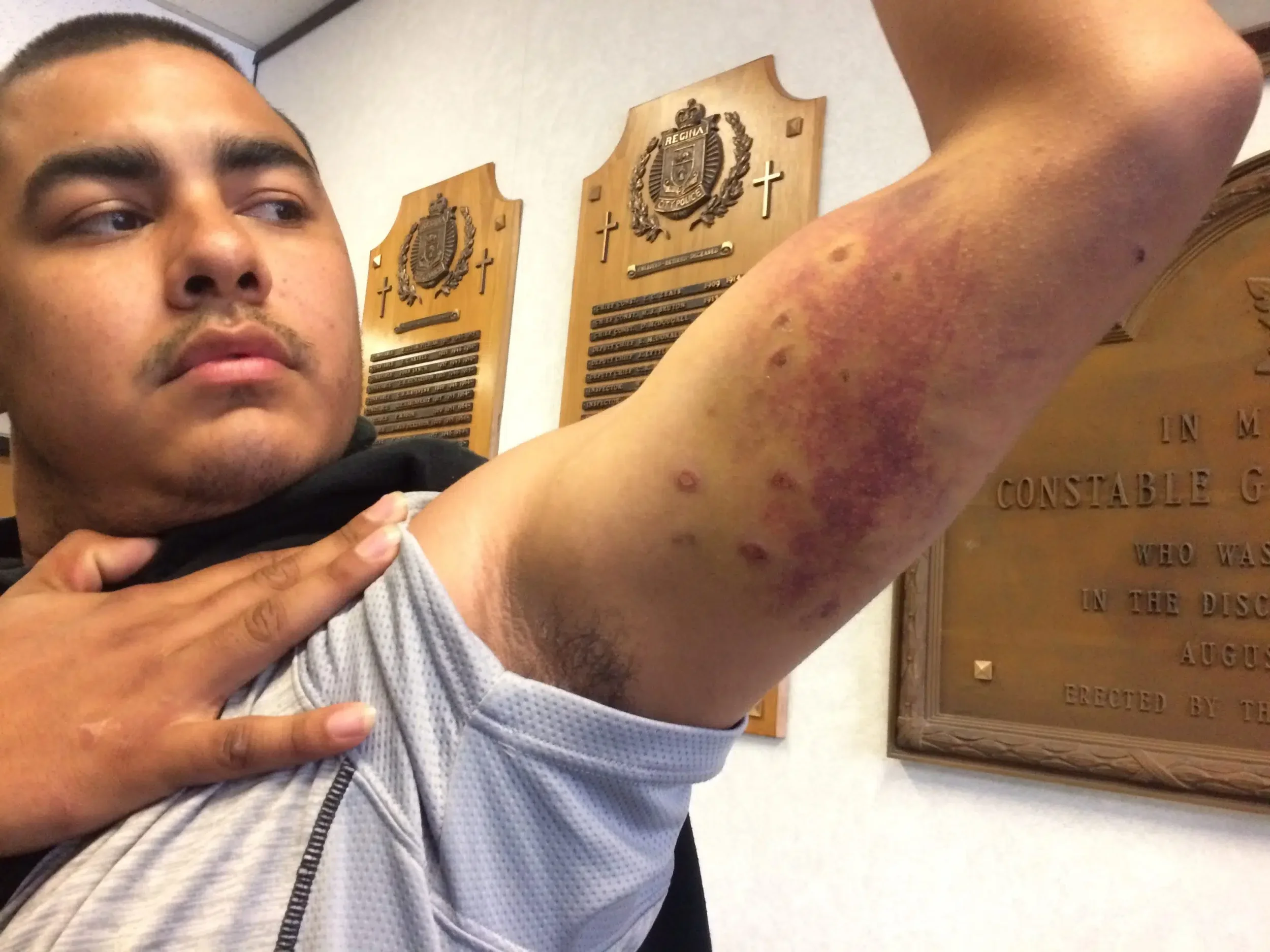
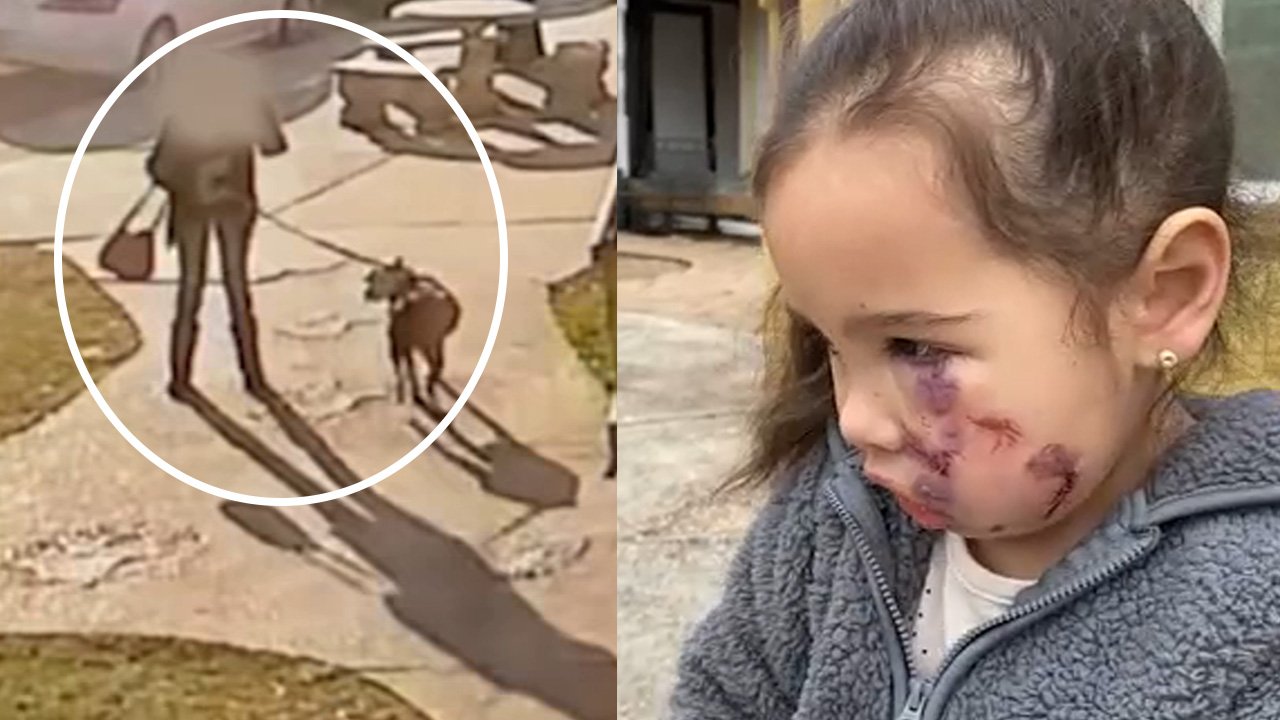
Actual Dog Bite Victims