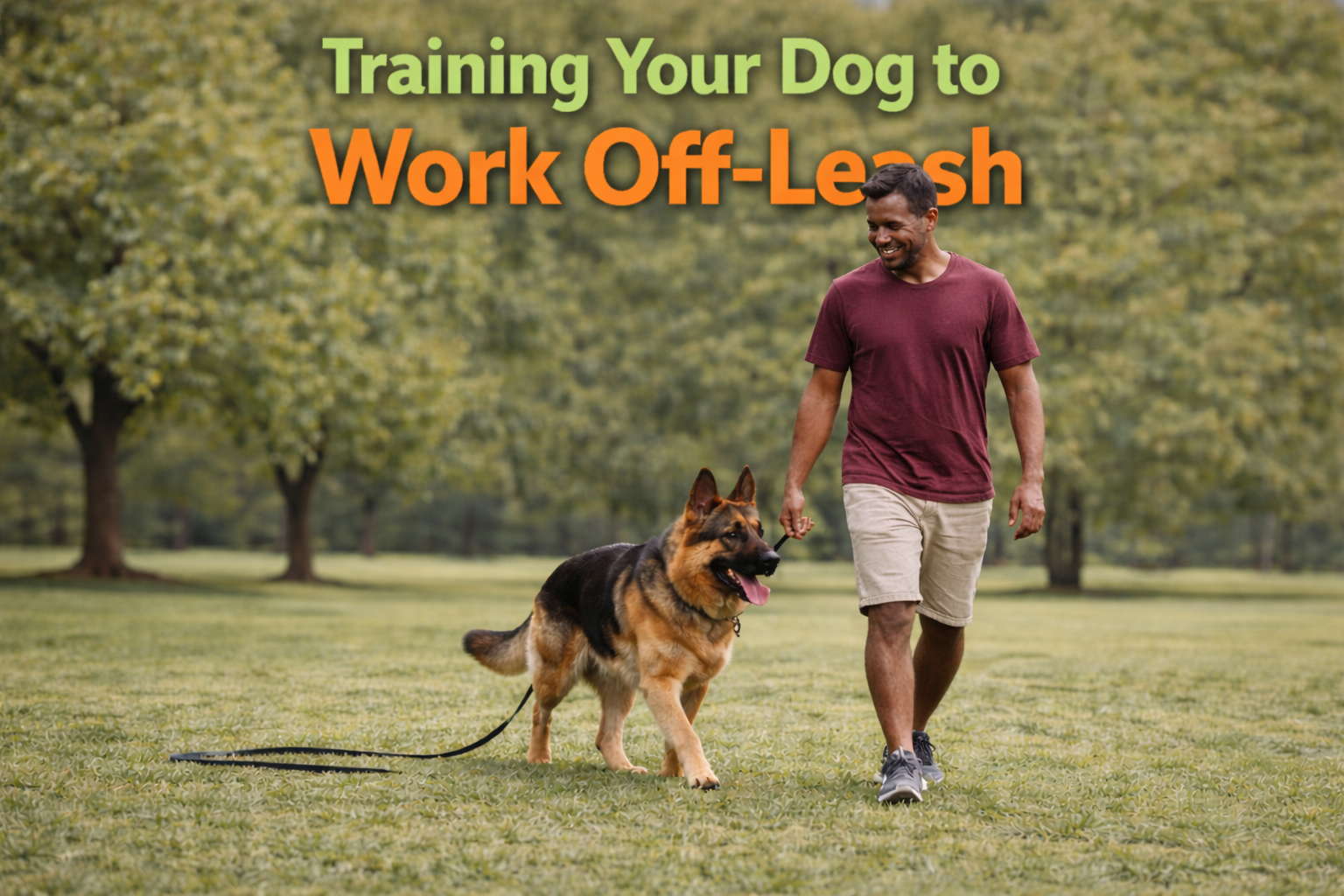
Training Your Dog to Work Off-Leash
By George Walker – Walker’s K9 Services, Tucson AZ
Working your dog off-leash isn’t just a cool party trick—it’s a major milestone that shows your dog understands boundaries, respects your leadership, and can make good decisions even they without constant management. But here’s the key: off-leash freedom isn’t something you give a dog… it’s something earn through structure, consistency, and a strong training foundation.
This guide walks dog owners through the exact steps to build safe, reliable off-leash control using balanced training principles.
1. Build Rock-Solid Foundation Skills First
Off-leash reliability starts long before the leash ever comes off.
Your dog should be consistent with the following skills on-leash:
Name recognition: immediate attention when called
Reliable recall (“Come”)
Sit / Down / Place
Loose-leash walking
Threshold manners and impulse control
If these aren’t solid with a leash on, they won’t be solid without one.
A dog’s off-leash reliability is simply their on-leash training… without the leash.
2. Start Long-Line Training
A long line (20–30 ft) is your safety net. It gives your dog freedom while keeping you in control.
With the long line, work on:
Distance recall
Holding commands from afar
Following directional changes
Staying focused around distractions
If the dog ignores the recall, the long line allows you to guide them back and try again—no drama, no chasing.
3. Layer in Training Tools for Clarity
Balanced training means clear communication, and off-leash work is where tools shine.
Most dogs benefit from:
E-collar (properly conditioned)
Prong collar during on-leash and long-line phases
A well-conditioned e-collar acts like a wireless long line. It’s not a punishment tool—it’s a communication tool that helps the dog understand what you’re asking, even at a distance.
Use calm pressure, pair it with known commands, and reward compliance.
This creates a confident, controlled dog that understands expectations anywhere.
4. Proof in Real-World Situations
Your dog must learn to perform under real-life distractions—not just in the backyard.
That means training in:
New locations
Busier environments
Areas with people, dogs, wildlife, sounds, and smells
Performance often dips in new areas. That’s normal. Your job is to guide, reinforce, and repeat until the behavior becomes reliable everywhere.
5. Test Before You Trust
Before you ever let your dog off-leash without backup, they should be able to:
Come the first time, even with distractions
Stay in command until released
Walk beside you without drifting
Make safe, smart choices without constant micromanaging
If you’re still repeating yourself or physically managing the dog, they’re not ready.
6. Introduce Off-Leash Freedom Gradually
Once your dog proves reliability, begin using safe, controlled environments like:
Fenced areas
Open fields
Hiking trails
Quiet natural spaces
You’re still supervising, still reinforcing, still giving structure.
Over time, the dog earns more freedom as they consistently make the right decisions.
7. Stay Involved—Training Never Stops
Even well-trained dogs need refreshers.
Weekly tune-ups can include:
A few structured recalls
Short place sessions
A clean off-leash heel
Impulse control reps
Consistency keeps off-leash reliability sharp.
Final Thoughts
A dependable off-leash dog doesn’t happen by chance—it’s built through structure, communication, and steady practice. When you lay the right foundation and follow the steps above, your dog becomes confident, trustworthy, and connected to you in a whole new way.
Off-leash freedom is one of the biggest privileges a dog can earn—but also one of the biggest responsibilities for the owner.
And remember: even with a well-trained dog, you should NEVER take your dog out in public off-leash.
Public spaces come with unpredictable people, dogs, wildlife, and laws you can’t control. Off-leash freedom should be reserved for safe, legal, controlled environments.
Smart training keeps your dog safe, respectful, and under control everywhere you go.
Dog Training in Tucson, AZ Dog Training in Marana, AZ Training Options
Please help us by sharing our training articles!
Written by: George Walker
Walker’s K9 Services – Tucson, AZ
520-500-7202