How Dogs Actually Learn (Timing, Pressure, and Release)
By George Walker, Walker’s K9 Services – Tucson, AZ
Understanding how dogs actually learn is one of the most misunderstood aspects of dog training. Many owners believe learning is driven primarily by treats, repetition, or the dog “figuring it out on their own.” While food and repetition can play a role, they are not the foundation of learning.
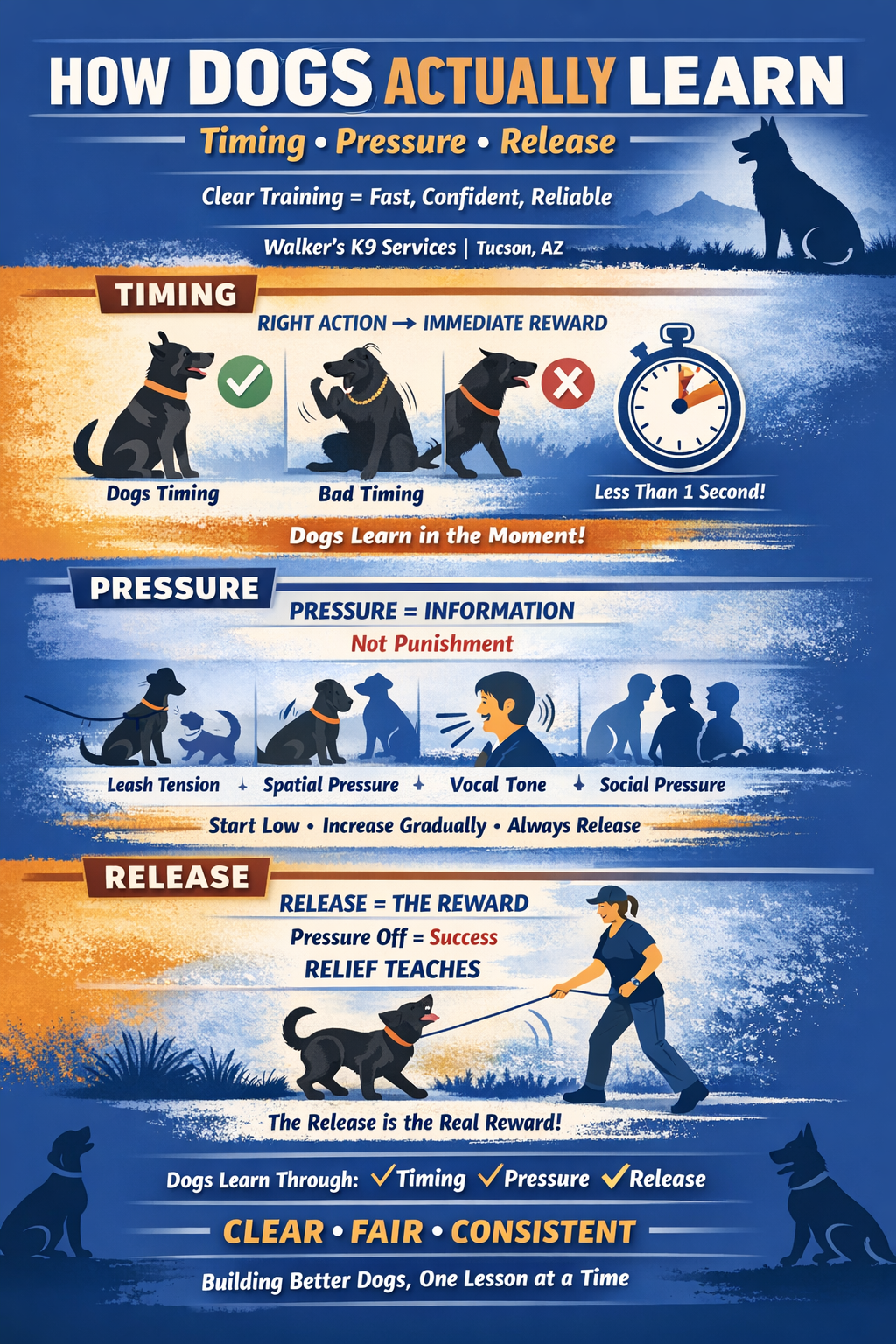
At its core, dog learning is about timing, pressure, and release. These three elements—when applied correctly—create clarity, confidence, and reliability in behavior. When applied incorrectly, they create confusion, stress, and inconsistency, no matter how many treats or repetitions you use.
This article breaks down how dogs truly learn, why timing matters more than strength, what “pressure” really means, and why the release is the most important part of all.
The Truth About Learning: Dogs Learn Through Consequences
Dogs are not moral thinkers. They don’t analyze behavior as “right” or “wrong.” Instead, dogs
learn through association:
What happened when I did that?
Did pressure increase or decrease?
Did something get better or worse?
Every behavior your dog offers is followed by a consequence—either intentional or accidental.
Learning happens when the consequence is clear, immediate, and consistent.
This is where timing, pressure, and release come into play.
Timing: The Difference Between Teaching and Confusing
Timing Is Everything
Dogs live in the moment. Their ability to associate cause and effect exists within a very small
window of time—usually less than one second. If your timing is off, the dog associates the
consequence with the wrong behavior.
For example:
You ask for a sit.
The dog sits.
Two seconds later you say “good boy” and give a reward.
To the human, this feels fine. To the dog, the reward may be associated with standing up, looking
away, or even scratching—not the sit itself.
Good Timing Looks Like This:
The instant the dog’s rear hits the ground → pressure stops or reward appears.
The moment the leash tightens → pressure begins.
The moment the dog yields → pressure disappears.
Dogs learn from the change, not the explanation.
Pressure: What It Is (and What It Isn’t)
Leash Correction as Pressure (Not Punishment)
A leash correction is not meant to hurt, scare, or intimidate a dog—it is a form of clear, momentary pressure designed to communicate information. When used correctly, a leash correction is brief, well-timed, and immediately followed by a release the instant the dog makes the correct choice. The correction itself is not what teaches; the absence of continued pressure is. Dogs learn that yielding to guidance turns pressure off, which creates clarity rather than fear. Poorly timed or prolonged leash corrections become noise and frustration, but a fair correction serves as a precise signal that helps the dog adjust and succeed. In balanced training, the leash is a communication line, not a weapon, and when pressure is applied correctly, it builds responsiveness, confidence, and reliability.
Pressure Is Information, Not Punishment
One of the biggest misconceptions in dog training is that pressure automatically means force, fear, or pain. In reality, pressure is simply any sensation the dog wants to turn off.
Pressure can include:
Leash tension
A Leash Pop
Spatial pressure (your body movement)
Vocal tone
Environmental pressure
Social pressure
Even withholding a reward can be a form of pressure.
Dogs naturally seek comfort and clarity. When pressure is applied correctly, it communicates, “This isn’t quite what I’m looking for—try something else.”
Pressure Should Always Be Fair and Scalable
Effective pressure:
Starts low
Increases gradually
Stops immediately when the dog makes the correct choice
This teaches the dog how to turn pressure off, which is the foundation of learning.
Poor pressure:
Comes on too strong
Is unpredictable
Continues even after the dog complies
This doesn’t teach—it overwhelms.
The Critical Role of Release
Release Is the Reward
Many owners focus heavily on the pressure but forget the most important part: the release.
The release of pressure is what teaches the dog what worked.
In fact, for many dogs, the release of pressure is more powerful than food.
Think of it this way:
Pressure asks the question
The dog answers with behavior
Release says, “Yes, that was it.”
If pressure doesn’t turn off instantly when the dog makes the correct choice, learning slows or stops entirely.
Why Release Must Be Immediate
Delayed release creates confusion. If your dog complies but pressure lingers:
The dog doesn’t know what behavior caused relief
The dog may try multiple behaviors rapidly
Anxiety and avoidance behaviors can develop
Clear learning requires:
Pressure on → dog tries → pressure off
Every time
How Dogs Learn Commands vs. Concepts
Commands Are Just Markers
Words like sit, down, or heel don’t mean anything to a dog at first. They are simply sounds that eventually become markers for a known behavior.
Dogs don’t learn words first—they learn physical actions and outcomes.
The correct order is:
Behavior is shaped through pressure and release
Dog consistently performs the behavior
Word is added as a label
When owners reverse this order, they get dogs who “know the command” but don’t respond reliably.
Why Repetition Alone Doesn’t Teach
Repeating commands does not teach a dog—it teaches the dog to ignore noise.
If a dog hears:
“Sit… sit… sit… SIT”
They learn that the first several cues are meaningless.
Learning happens when:
One cue is given
Pressure follows if needed
Release confirms success
Leash Pressure: One of the Most Misused Tools
The leash is one of the clearest communication tools available—yet it’s often used incorrectly.
Correct Leash Pressure:
Gentle tension or a leash pop appears
Dog yields into position
Leash immediately relaxes
Incorrect Leash Pressure:
Constant tension
Pressure remains even after compliance
Dogs trained with constant leash pressure often become dull, resistant, or dependent on force.
Dogs trained with clear pressure and release become responsive and light.
Spatial Pressure: How Body Language Teaches
Dogs are experts at reading movement and space.
You can apply pressure by:
Stepping into space
Blocking movement
Turning shoulders
Changing posture
You release pressure by:
Stepping away
Softening posture
Turning sideways
Relaxing your stance
This type of pressure is especially powerful because it mirrors canine communication.
Emotional State Matters More Than Tools
Dogs don’t just respond to mechanics—they respond to emotional clarity.
If the handler is:
Frustrated
Angry
Inconsistent
The dog feels uncertainty, even if the timing is correct.
Calm, neutral energy paired with clear timing creates the fastest learning.
Why Dogs Shut Down or Push Back
When pressure is applied without clear release, dogs respond in one of three ways:
Avoidance – refusing to engage
Shutdown – learned helplessness
Resistance – pushing through pressure
None of these are learning. They are coping mechanisms.
True learning looks like:
The dog actively trying
The dog offering behaviors
The dog becoming faster and lighter over time
Proof That Dogs Learn Through Release
Watch a well-trained working dog:
Pressure is subtle
Movements are minimal
Responses are immediate
This is not because the dog is afraid—it’s because the dog understands exactly how to find relief and success.
How This Applies to Everyday Training
Teaching a Sit
Apply upward leash pressure
Dog lowers rear
Pressure instantly releases
Teaching Loose Leash Walking
Leash tightens
Dog slows or turns back
Leash slackens immediately
Teaching Place or Down
Spatial or leash pressure guides
Dog settles
Pressure disappears
In each case, release teaches the lesson.
Why Food Alone Isn’t Enough
Food can motivate behavior, but it does not teach clarity by itself.
Without pressure and release:
Dogs perform only when food is visible
Reliability drops under distraction
The dog never learns how to solve pressure
Balanced training doesn’t remove rewards—it places them on top of understanding
Clarity Creates Confidence
Dogs that understand pressure and release:
Become calmer
Make better choices
Recover faster from mistakes
Trust the handler
Confident dogs are not created by permissiveness—they are created by clarity.
Final Thoughts: Learning Is Mechanical, Not Emotional
Dogs don’t need long explanations or endless repetitions. They need:
Clear timing
Fair pressure
Immediate release
When those three elements are consistent, learning becomes fast, humane, and reliable.
If you want a dog that listens under distraction, responds without bribery, and remains emotionally stable, you must understand how learning actually works.
They learn because we communicate better.
Dog Training in Tucson, AZ Dog Training in Marana, AZ Training Options
Walkers K9 Services — Building Better Dogs, One Lesson at a Time
Please support our mission by sharing our training articles with other dog owners.
Written by: George Walker
Walkers K9 Services | Tucson & Marana, AZ
520-500-7202
www.WalkersK9Services.org