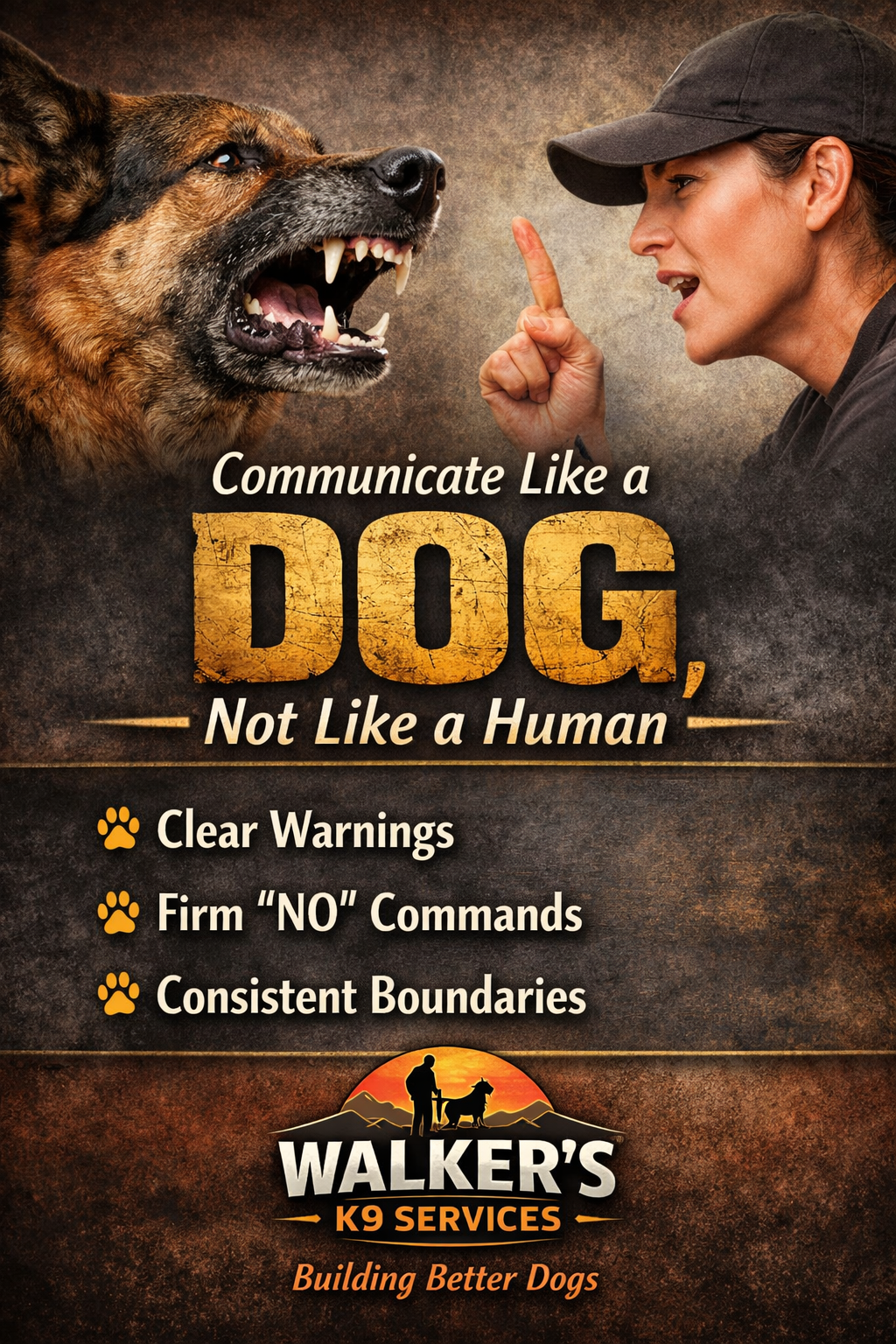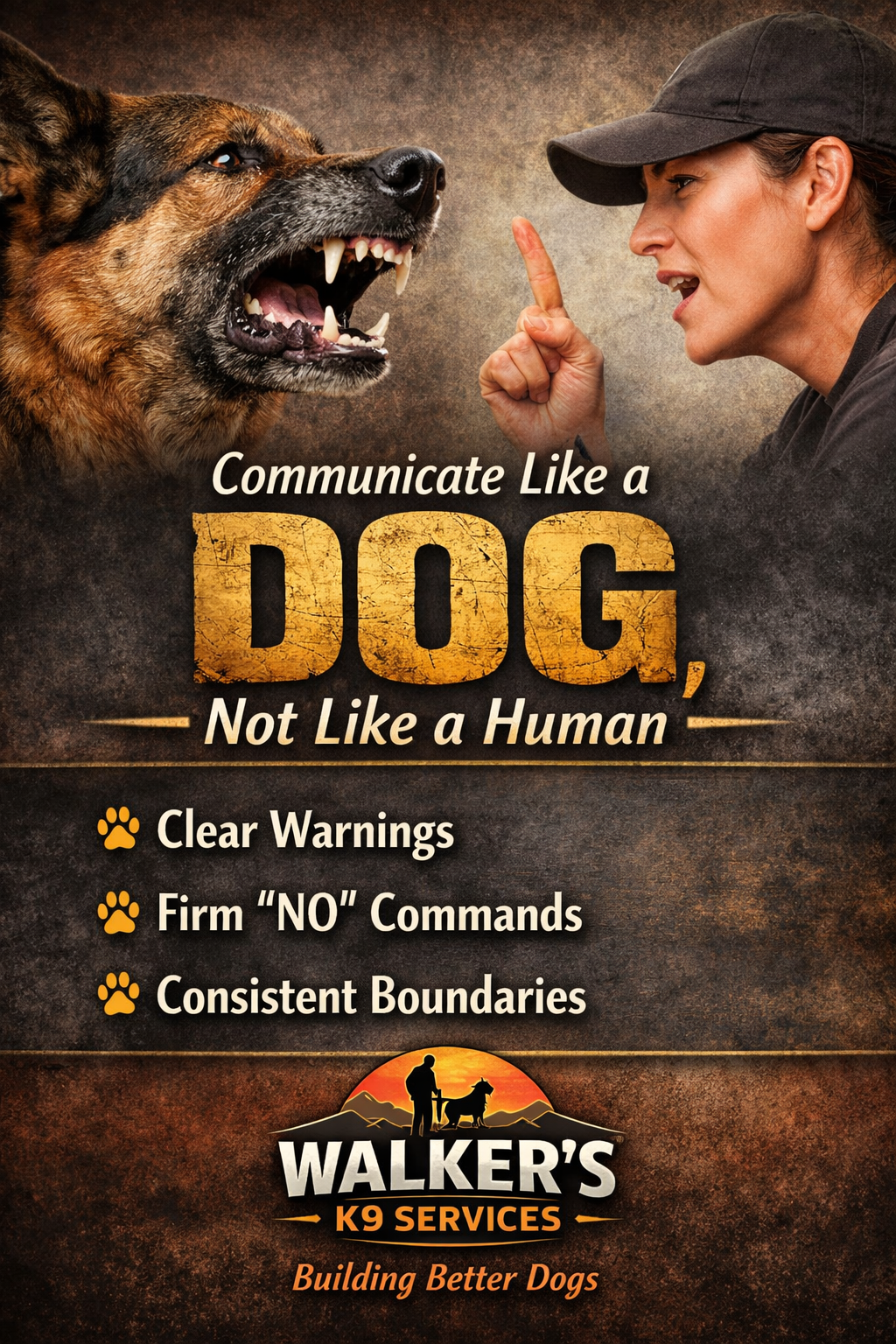
Why “No” Isn’t a Bad Word:
Communicating With Dogs the Way They Understand
By George Walker, Walker’s K9 Services – Tucson, AZ
I met a young lady this morning for a training consultation who had recently worked with another trainer. During our conversation, she explained that she had been instructed to never use the verbal correction “NO” with her dog and to never raise her voice under any circumstances.
This wasn’t the first time I’ve heard this.
Over the years, I’ve had multiple clients tell me they were given the exact same advice by different trainers. While I understand the intention behind it—avoiding fear-based handling or emotional outbursts—it’s important to stop and really think about this advice from the dog’s point of view, not a human one.
How Dogs Naturally Communicate Boundaries
Dogs do not communicate like humans. They don’t use polite language, long explanations, or
emotional reasoning. They communicate through clear, escalating signals.
If one dog is doing something to another dog that it doesn’t like, here’s what typically happens:
Initial warning – A growl, a hard stare, or showing teeth
Escalation – Louder vocalizations or more intense body language
Final consequence – A snap or physical correction if the behavior continues
This progression is normal, natural, and effective communication in the canine world.
What “No” Actually Means to a Dog
When an owner uses a firm verbal correction like “NO”, they are not being abusive or
emotional—they are doing something very important:
They are replicating the dog’s natural warning system.
A calm but firm “NO” mirrors a growl or warning display
A louder verbal correction mirrors escalation when the behavior continues
In some cases, a properly timed leash correction mirrors the snap that ends
unwanted behavior
This isn’t about anger or yelling. It’s about clarity.
Dogs thrive on clear, consistent communication. When corrections are fair, well-timed, and proportional, dogs understand exactly what is being asked of them.
The Problem With “Human Language” Training
One of the biggest mistakes owners make—often unintentionally—is trying to communicate with dogs using human emotion and human reasoning.
Talking softly, pleading, or explaining why a behavior is wrong might make sense to another person, but to a dog it’s the equivalent of speaking a foreign language.
Dogs don’t process:
Guilt
Long explanations
Emotional tone without meaning
They process:
Timing
Tone
Consistency
Consequences
When communication lacks clarity, dogs become confused, frustrated, or anxious—and problem behaviors often get worse, not better.
Firm Does Not Mean Mean
There is a huge difference between:
Clear, confident leadership
Angry, emotional outbursts
Using “NO” appropriately does not mean yelling, intimidating, or frightening a dog. It means setting boundaries in a way that dogs instinctively understand.
Avoiding all verbal corrections out of fear of being “too harsh” often leads to inconsistent rules, unclear expectations, and dogs that don’t truly understand where the boundaries are.
Training Is About Understanding the Dog, Not Human Comfort
Effective dog training isn’t about what sounds nice to people—it’s about what works for dogs.
When we communicate in a way dogs naturally understand, we create:
Clear expectations
Reduced anxiety
Faster learning
Safer behavior
Dogs don’t need constant softness. They need fair structure, clear communication, and consistent leadership.
When we stop trying to make dogs think like humans—and instead learn to communicate like dogs—we set both the dog and the owner up for long-term success.
Dog Training in Tucson, AZ Dog Training in Marana, AZ Training Options
Walkers K9 Services — Building Better Dogs, One Lesson at a Time 🔹
Please support our mission by sharing our training articles with other dog owners.
Written by: George Walker
Walkers K9 Services | Tucson & Marana, AZ
📞 520-500-7202