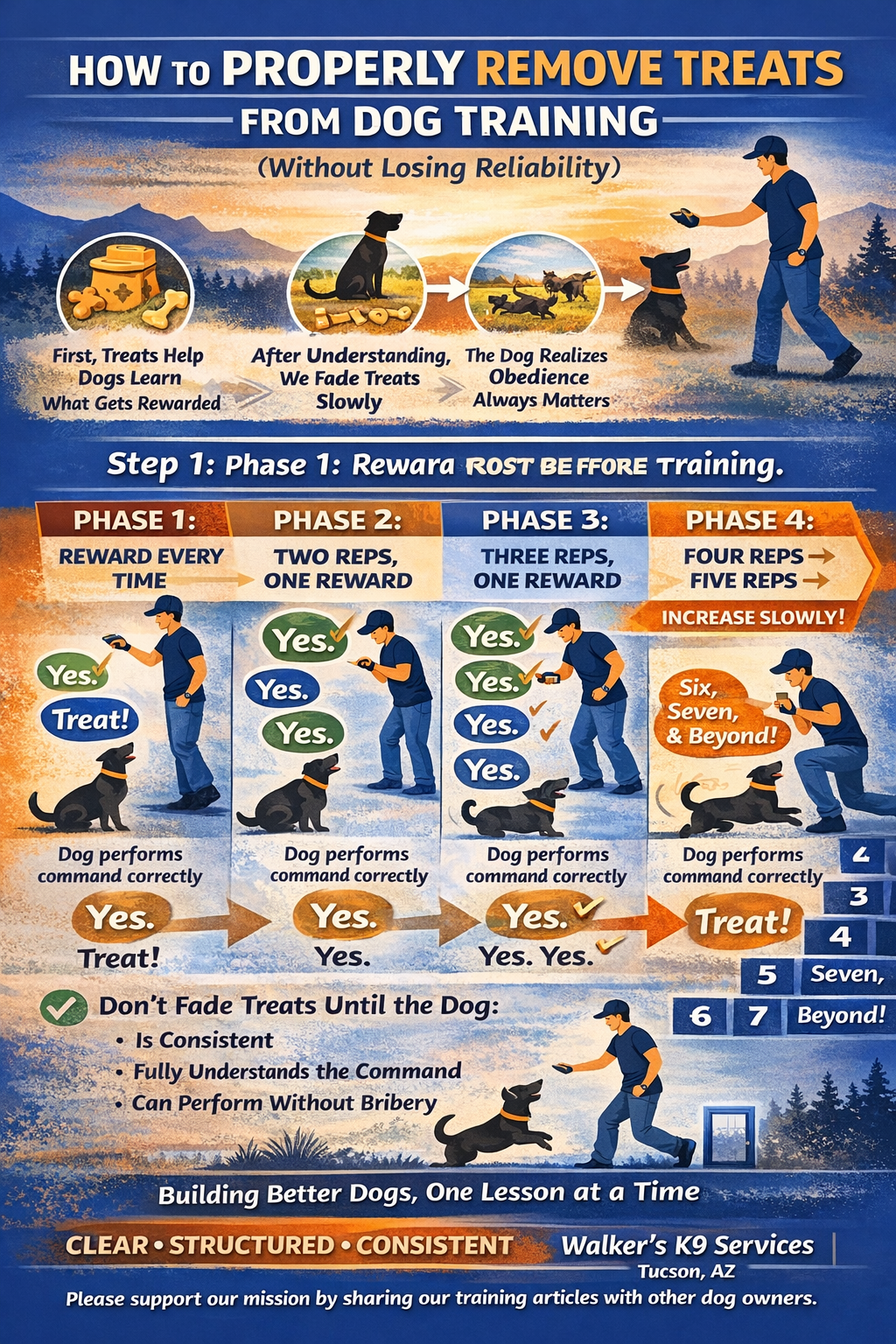
How to Properly Remove Treats From Dog Training
(Without Losing Reliability)
By George Walker, Walker’s K9 Services – Tucson, AZ
Treats are one of the most useful tools in early training—but they were never meant to be permanent. One of the most common frustrations dog owners experience is a dog who “listens great when food is out” and completely ignores commands when it’s not. This isn’t a stubborn dog. It’s a dog that was never properly transitioned off food.
Removing treats the right way doesn’t reduce reliability—it increases it. When done correctly, the dog learns that obedience itself is expected, not optional based on whether food is visible.
Let’s walk through how dogs actually learn with food, why many owners get stuck, and how to systematically wean treats without breaking behavior.
Why Treats Work (At First)
Food is a primary reinforcer, meaning dogs are biologically wired to value it.
In early training, treats are excellent for:
Creating motivation
Marking correct behavior
Building engagement
Helping the dog understand what earns reward
In the beginning, dogs should absolutely be paid every time they perform a
new command correctly. This creates a clear connection between:
Behavior → Marker → Reward
Skipping rewards too early creates confusion and slows learning.
The Mistake Most Owners Make
Where things go wrong is not the use of treats—it’s never removing them.
If a dog only works when:
Treats are visible
The owner is holding food
The dog expects immediate payment
Then the dog has learned condition-based obedience, not obedience.
The goal of training is not a dog who works for food, but a dog who works
because they understand.
Step One: Proof the Behavior Before Removing Treats
Before you reduce treats, the dog must meet three criteria:
Consistency – The dog performs the behavior correctly at least 90% of the time
Understanding – The dog responds to the command without hesitation
Low Distraction Success – The dog can perform the behavior in familiar environments
If the dog is still guessing, hesitant, or needs constant help, it’s too early to reduce rewards.
Food fades after understanding, not before.
Step Two: Move From Continuous to Variable Reward
In early training, treats are given on a continuous schedule—every correct repetition earns a reward.
Once the dog understands the command, you begin transitioning to a variable schedule.
This is where many people go wrong. Variable does NOT mean random at first. It means structured reduction.
The Proper Weaning Process (2, 3, 4, etc.)
Here’s how it should look:
Phase 1: Reward Every Time
Dog performs command → “Yes” → Treat
This builds understanding and motivation
Phase 2: Two Repetitions for One Reward
Dog performs the command correctly twice before earning a treat
Marker (“Yes”) still happens each time
Treat comes after the second success
This teaches the dog that effort continues even without immediate payment.
Phase 3: Three Repetitions for One Reward
Dog performs the command three times correctly
Marker still confirms each success
Treat comes after the third repetition
At this stage, obedience becomes more about compliance than food.
Phase 4: Four, Five, and Beyond
Gradually increase the number of correct repetitions required
Rewards become less frequent but more meaningful
The dog learns that:
“I may not get paid every time, but doing the command always matters.”
Why This Works Psychologically
Dogs don’t stop working when food becomes less predictable—they often work harder.
This is the same principle used in:
Slot machines
Gambling behavior
High-performance working dogs
Variable reinforcement creates engagement and persistence, as long as the dog understands the rules.
The key is gradual change, not sudden removal.
Keep the Marker Strong
As treats fade, marker words become more important.
Your “Yes” still tells the dog:
That behavior was correct
Reward may come now or later
Never remove the marker when removing food. The marker bridges clarity.
If the dog never knows whether they did the right thing, reliability collapses.
Replace Food With Life Rewards
As food fades, begin layering in real-world rewards, such as:
Praise
Release to freedom
Access to toys
Going outside
Sniffing
Social interaction
For example:
Sit → “Yes” → Door opens
Heel → “Yes” → Leash pressure releases
Down → “Yes” → Freedom
The dog learns that obedience controls the environment, not just the treat pouch.
Don’t Remove Treats Under High Distraction Too Soon
A common mistake is removing treats in situations where the dog is not ready:
New environments
Heavy distractions
High excitement
In those cases, temporarily bring food back to maintain clarity.
Fading treats is not linear. You may reduce them in one environment and increase them in another. That’s normal.
What Happens If the Dog Stops Responding?
If reliability drops:
You faded too fast
The dog doesn’t fully understand
Distractions are too high
The solution is not punishment—it’s clarity.
Go back one step:
Reduce the number of repetitions required
Increase reward frequency
Rebuild confidence
Then continue forward again.
Why Bribery Fails (and Training Succeeds)
Bribery looks like this:
Show the dog food
Dog obeys
Food disappears → obedience disappears
Training looks like this:
Command given
Dog responds
Marker confirms
Reward appears later
The food should never be the cue.
The End Goal: Food as a Bonus, Not a Requirement
Eventually, treats become:
Occasional
Unexpected
High-value bonuses
At this stage:
Commands are followed without visible rewards
Food enhances performance but doesn’t control it
Reliability remains even when rewards are absent
That’s real training.
Final Thoughts
Treats are a tool—not a crutch.
Use them heavily in the beginning.
Fade them gradually with structure.
Replace them with clarity, markers, and real-world rewards.
When dogs understand what is expected, they don’t need to be bribed.
They comply because the rules are clear.
That’s how reliable obedience is built.
Dog Training in Tucson, AZ Dog Training in Marana, AZ Training Options
Walkers K9 Services — Building Better Dogs, One Lesson at a Time
Please support our mission by sharing our training articles with other dog owners.
Written by: George Walker
Walkers K9 Services | Tucson & Marana, AZ
520-500-7202