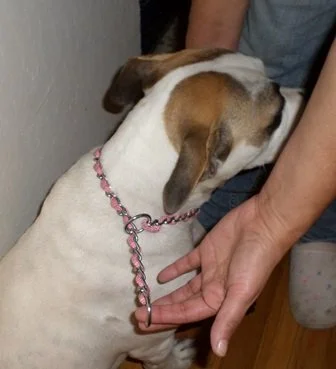
How to Properly Put On and Use a Choke Chain (Slip Collar)
By George Walker, Walker’s K9 Services – Tucson, AZ
Choke chains—more accurately called slip collars—are one of the most misunderstood training tools in dog training. When used correctly, they are a clear, effective communication tool. When used incorrectly, they can be uncomfortable, ineffective, or even dangerous.
This article explains how to properly put on a choke chain, how it should be used, and what it should never be used for.
What a Choke Chain Is (and Is Not)
A choke chain is simply a training collar.
✔ It is designed to tighten briefly and release immediately
✔ It is meant for short, clear corrections
✘ It is not meant to stay tight
✘ It is not meant for constant pulling or restraint
✘ It is not a punishment device
When used correctly, a choke chain provides momentary pressure on the dog’s neck,
followed by instant release, which is how dogs learn. This is kind of like someone tapping
you on the shoulder and saying I’m talking to you now pay attention.
How to Properly Put On a Choke Chain
This step matters more than most people realize. A choke chain worn backward does
not release properly and turns into constant pressure—exactly what we don’t want.
Step-by-Step Placement
Hold the chain in a “P” shape
When you look at it, it should resemble the letter P, not q. An easy way to remember that is, P is for Perfect and Q is for Quit.
Slip it over the dog’s head
The free-moving end of the chain should come over the top of the neck, not underneath.
Attach the leash to the live ring
The ring that allows the chain to tighten and loosen freely.
✅ When put on correctly, the collar tightens and releases smoothly
❌ When put on incorrectly, it sticks and applies constant pressure
Proper Fit Matters
The chain should be long enough to slide easily
It should never be tight when the leash is relaxed
If it doesn’t release instantly, it’s either:
The wrong size
Put on backward
Being used incorrectly
How to Properly Use a Choke Chain
A choke chain is not about force—it’s about timing and clarity.
The Correct Correction
✔ A quick snap and release of the leash using a verbal correction at the same time “NO”
✔ Pressure lasts less than a second
✔ The leash immediately returns to slack
Think of it as tap → release, not pull → hold.
What the Correction Means to the Dog
“That behavior was incorrect”
Not: “I’m being restrained”
Not: “I’m being punished”
Not: “I’m choking”
Dogs learn from contrast—pressure on, pressure off. The release is what teaches.
What NOT to Do With a Choke Chain
🚫 Do not constantly pull on the leash
🚫 Do not let the chain stay tight
🚫 Do not use it as a tie-out
🚫 Do not use it for jogging or long-line walking
🚫 Do not leave it on an unsupervised dog
A choke chain used with constant tension becomes ineffective and unfair.
When a Choke Chain Is Appropriate
Choke chains are commonly used for:
Teaching loose-leash walking
Mild to moderate leash corrections
Clear communication with dogs that ignore flat collars
They are not ideal for:
Puppies
Very small dogs
Dogs with neck or trachea issues
Handlers who cannot maintain timing and leash control
Why Technique Matters More Than the Tool
A choke chain does not train a dog—the handler does.
Used correctly:
The dog stays calm
Communication is clear
The collar may become unnecessary over time
Used incorrectly:
The dog learns nothing
The handler gets frustrated
The tool gets blamed instead of the technique
Final Thoughts
A choke chain is a precision tool, not a blunt instrument. When properly fitted, placed, and used with good timing, it can be a safe and effective part of a balanced training program.
If you’re unsure whether you’re using it correctly, working with an experienced trainer can make all the difference—for both you and your dog.
Dog Training in Tucson, AZ Dog Training in Marana, AZ Training Options
Walkers K9 Services — Building Better Dogs, One Lesson at a Time 🔹
Please support our mission by sharing our training articles with other dog owners.
Written by: George Walker
Walkers K9 Services | Tucson & Marana, AZ
📞 520-500-7202