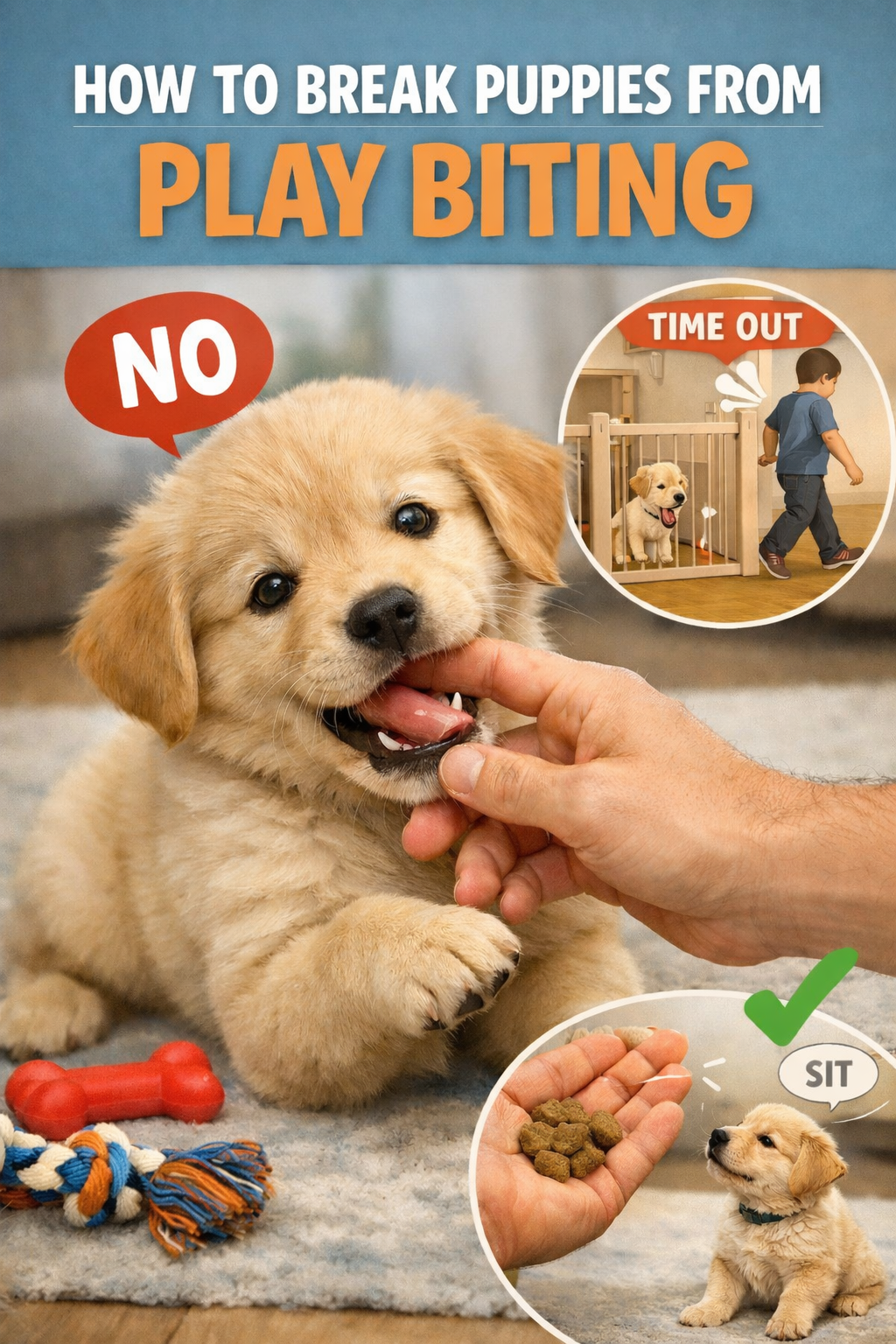
How to Break Puppies From Play Biting
By George Walker – Walker’s K9 Services, Tucson AZ
Puppy teeth are tiny needles, and every new dog owner learns that fast. Play biting is one of the most common complaints I hear, and while it’s normal puppy behavior, it’s not something you want to ignore. If you don’t address it early, it becomes a habit that follows the dog into adolescence—and correcting a 60–80 lb teenager is a whole different experience.
The good news? With the right structure, consistency, and boundaries, you can stop play biting quickly and humanely. I never allow my puppies to put their mouth on any part of me or my cloths.
Why Puppies Bite in the First Place
Puppies use their mouths to explore the world. They’re teething, overstimulated, curious, and testing boundaries. In a litter, the other puppies correct each other constantly. Once they go home, you become the littermate—and if you don’t provide the same structure, the biting continues unchecked.
Your job isn’t to punish the puppy.
Your job is to teach rules.
Step-by-Step: How to Stop Play Biting
1. Stop Playing When Teeth Touch Skin
This is the fastest and most effective rule.
The moment teeth make contact with your hand, arm, or clothes:
Stop the play instantly
Stand up or turn away
No eye contact
No talking
The message is simple:
“Biting makes fun stop.”
Dogs learn patterns quickly. If biting consistently ends the game, they start controlling their mouths.
2. Redirect to an Appropriate Toy
Puppies don’t just stop biting because you want them to—they need something else to put their energy into.
Offer:
A rope toy
A soft tug toy
A stuffed toy
A rubber chew
If the puppy redirects, praise calmly.
If not? Play stops again.
This teaches them the difference between skin = no, toy = yes.
3. Use Calm, Firm Interruptions (Not Yelling)
A lot of owners get frustrated and shout “NO!”
Instead, use a clear, firm interrupter:
“Ah-ah”
“Nope or No”
“Hey”
Short, neutral, and to the point.
The goal is to interrupt—not escalate the puppy’s energy.
4. Slow the Puppy Down
Most biting comes from overarousal.
If the puppy is:
Zooming around
Jumping
Nipping nonstop
Ignoring toys
They’re overstimulated.
Put the puppy:
On a leash nearby
In a crate for a short break
On a place cot to calm down
Calmness is a skill.
You’re teaching them how to relax—something many puppies don’t know how to do on their own.
5. Start Basic Obedience Early
Sit, down, place, and recall are not just “commands”—they build impulse control. A trained mind bites less.
Training gives the puppy a job, creates respect, and teaches them how to slow their brain down. A tired, mentally worked puppy is far less mouthy.
6. Never Reward the Biting
Most people accidentally reinforce play biting.
Common mistakes:
Pushing the puppy away (turns into a game)
Pulling your hand back fast (game)
Laughing because it’s “cute” (reinforcement)
Wrestling on the floor (guaranteed biting)
Every reaction trains something.
Make sure you’re training the right thing.
7. Be Consistent—Everyone in the Home
A puppy trained by one person and allowed to bite by another will always choose the easier option.
Make sure everyone uses:
The same rules
The same interrupters
The same redirection method
The same calm demeanor
Consistency = clarity.
When Play Biting Isn’t Normal
If the puppy:
Bites with intensity
Shows guarding
Growls in a threatening way
Doesn’t respond to any interruption
Escalates to real aggression
That’s not “normal puppy behavior.”
That’s a red flag.
Get professional help early.
The earlier you address it, the easier the fix.
Final Thoughts
Play biting doesn’t mean your puppy is “bad”—it means they’re young and learning how to live in a human world. With structure, redirection, calm corrections, and clear rules, you can stop mouthy behavior quickly and set your puppy up for a lifetime of good manners.
Build good habits now, and you won’t be fighting big problems later.
Dog Training in Tucson, AZ Dog Training in Marana, AZ Training Options
Please help us by sharing our training articles
Written by: George Walker
Walker’s K9 Services – Tucson, AZ
520-500-7202