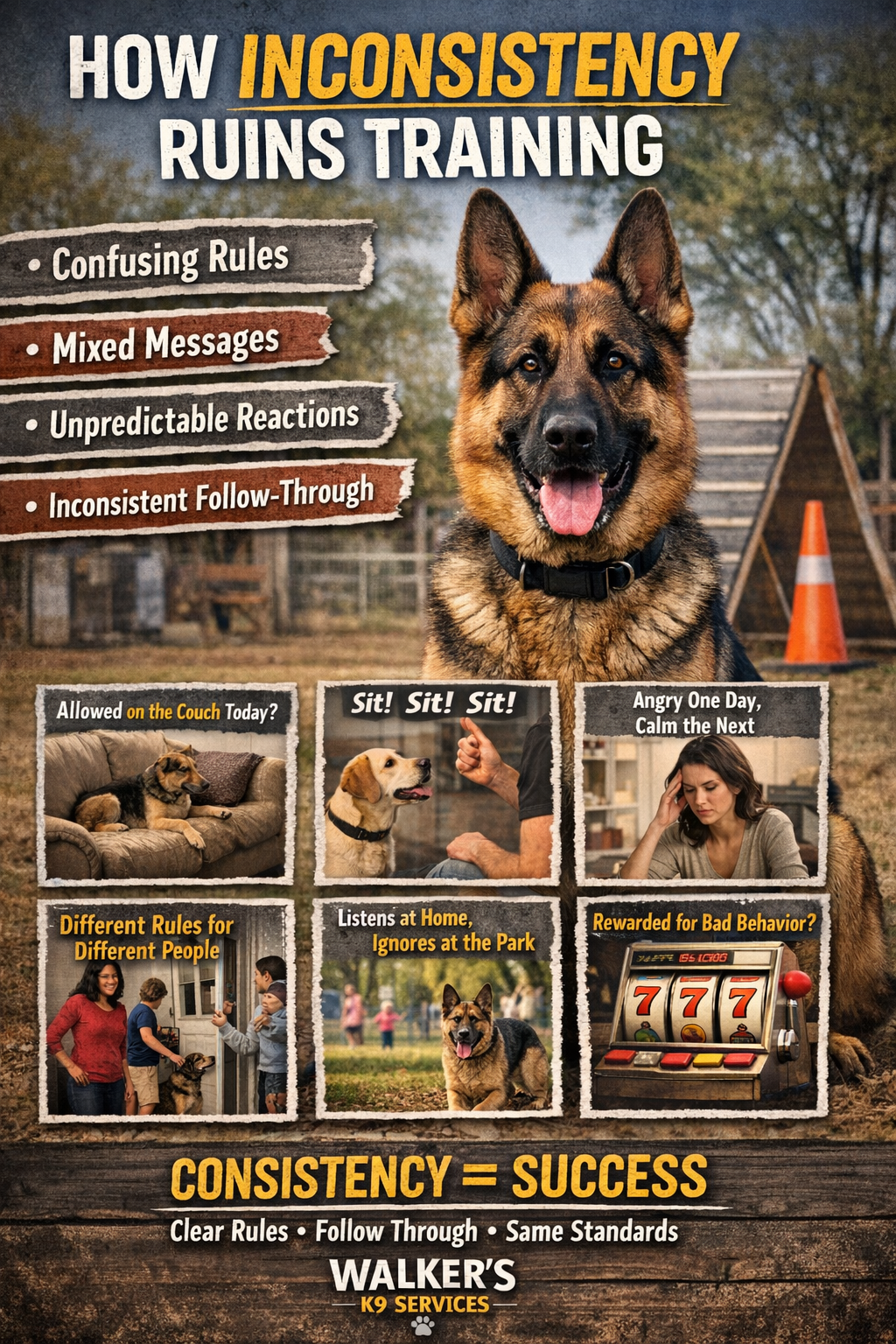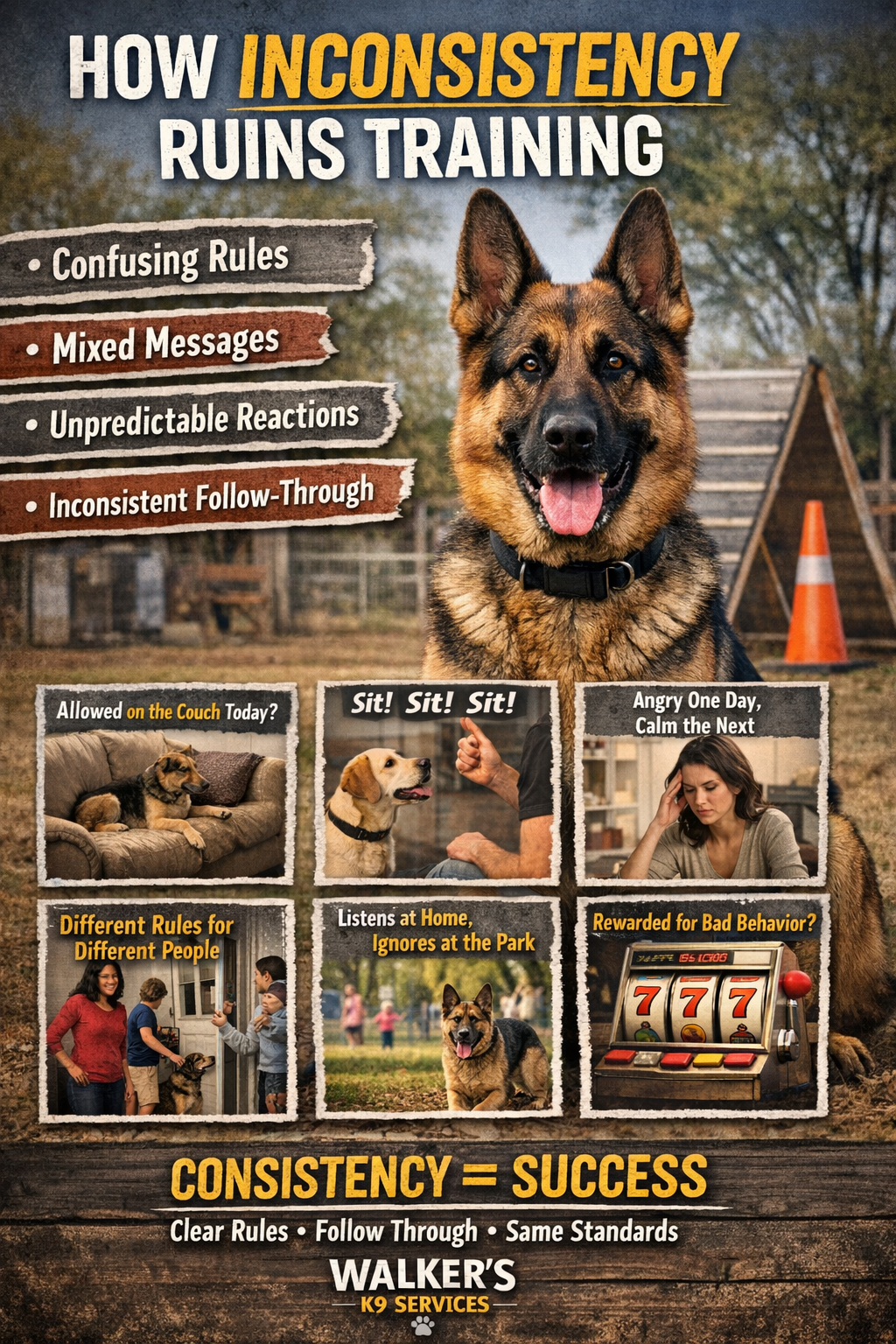
How Inconsistency Ruins Training
By George Walker, Walker’s K9 Services – Tucson, AZ
One of the biggest reasons dogs fail in training has nothing to do with intelligence, stubbornness, or breed. It has everything to do with inconsistency.
Inconsistent rules.
Inconsistent timing.
Inconsistent follow-through.
Inconsistent consequences.
Dogs thrive on clarity. When that clarity disappears, confusion replaces it — and confusion always looks like “bad behavior.”
If your dog listens sometimes but not others, behaves at home but not in public, or obeys one family member but ignores another, inconsistency is almost always the root problem.
Let’s break down why.
Dogs Learn Through Patterns
Dogs do not learn through lectures or explanations. They learn through patterns and repetition.
When a behavior consistently leads to a reward, it strengthens.
When a behavior consistently leads to a correction or removal of reward, it weakens.
But when the outcome changes randomly?
The behavior becomes unpredictable — and unpredictable behavior becomes unreliable behavior.
For example:
If “Sit” means sit immediately every time, the dog understands the rule.
If “Sit” sometimes means sit, sometimes means sit after five repeats, and sometimes gets
ignored altogether, the dog learns something very different.
The dog learns:
“I’ll sit when I feel like it.”
That isn’t defiance. That’s conditioning.
Inconsistency Creates Testing
Dogs are problem-solvers. If they discover that pushing boundaries works sometimes, they will keep pushing.
Here’s a common scenario:
Day 1: Dog jumps on the couch. Owner says no and removes them.
Day 2: Dog jumps on the couch. Owner is tired and allows it.
Day 3: Dog jumps on the couch. Owner gets angry and yells.
From the dog’s perspective, the rule is unclear. So the dog keeps trying.
When rules are inconsistent, dogs do not “learn better.”
They learn to test harder.
Emotional Inconsistency Is Just as Damaging
Many owners think inconsistency only applies to commands, but emotional inconsistency is just as harmful.
Example:
Dog pulls on leash.
One day the owner calmly corrects and redirects.
Another day the owner explodes in frustration.
Now the dog isn’t just confused about leash rules — they’re confused about you.
Dogs look to their handler for stability. If the handler’s reactions are unpredictable, the dog’s confidence drops. Anxiety rises. Reactivity increases.
Calm, predictable leadership builds security.
Emotional swings build uncertainty.
Repeating Commands Weakens Them
One of the most common training mistakes is repeating commands.
“Sit.”
“Sit.”
“Sit.”
“Sit!”
What did the dog learn?
They learned that the command does not matter until it’s been repeated four times or said in an angry tone.
If you always repeat commands, you are unintentionally training delayed obedience.
Consistency means:
Say it once.
Give the dog the opportunity to comply.
Follow through appropriately.
Every single time.
Family Inconsistency Is a Major Problem
In many households, one person trains seriously and everyone else undoes the work.
Examples:
One person enforces no jumping. Others allow it.
One person requires calm door manners. Others let the dog bolt.
One person requires structured feeding. Others free-feed.
To the dog, there aren’t “different rules for different people.” There are just unclear rules.
Dogs don’t generalize well without guidance. If rules change depending on who is present, training slows down drastically.
Consistency across all family members is not optional. It is foundational.
Inconsistency Rewards the Wrong Behavior
Dogs repeat what works.
If barking at the door gets attention sometimes, barking will increase.
If whining gets let out of the crate occasionally, whining will intensify.
If pulling on leash sometimes gets them where they want to go faster, pulling becomes reinforced.
Even one success can reset progress.
Think of it like this:
If you played a slot machine and won occasionally, would you stop playing?
No. You’d play more.
Intermittent rewards create stronger behaviors than consistent rewards. When owners accidentally reward unwanted behaviors randomly, they make those behaviors extremely persistent.
Training in One Environment Isn’t Enough
Another form of inconsistency is environmental.
A dog that listens perfectly in the living room but ignores commands at the park is not “being stubborn.” They are simply undertrained in new environments.
Dogs must learn that commands mean the same thing everywhere:
Indoors
Outdoors
Around distractions
Around other dogs
Around children
Around wildlife
If you only train in one environment, obedience becomes situational instead of universal.
Consistency means taking the same standards into every setting.
Consequences Must Match the Behavior
Consistency doesn’t mean being harsh. It means being fair and predictable.
If a dog disobeys:
The correction should be timely.
The correction should match the level of disobedience.
The correction should stop once compliance happens.
If sometimes disobedience is ignored and sometimes it results in explosive frustration, the dog never clearly understands expectations.
Fair and consistent pressure, followed by release when the dog makes the correct choice, creates clarity.
Clarity creates confidence.
Why Dogs Seem “Stubborn”
When people say, “My dog is stubborn,” what they usually mean is:
“My dog has learned that commands are optional.”
And that almost always traces back to inconsistency.
If a dog has learned:
They only have to sit when treats are visible.
They only have to come when they feel like it.
They only have to heel when the leash is tight.
Then the dog is not stubborn. They are responding to a history of inconsistent reinforcement.
Dogs do exactly what their training has prepared them to do.
The Power of Clear Standards
If you want reliable obedience, ask yourself:
Are the rules the same every day?
Do I follow through every time?
Does every family member enforce the same standards?
Am I emotionally stable during corrections?
Do commands mean the same thing in every environment?
Training improves dramatically when the answers to those questions become consistent.
Consistency does not require perfection.
It requires commitment.
Small Slips Turn Into Big Problems
Most major behavioral problems start small:
A little pulling.
A little jumping.
A little barking.
A little ignoring commands.
When those small behaviors are allowed occasionally, they grow.
What gets tolerated gets repeated.
What gets repeated gets strengthened.
By the time an owner decides to “get serious,” the behavior has already been reinforced dozens or hundreds of times.
Consistency from day one prevents escalation.
How to Fix Inconsistency
Here’s where to start:
Define Clear Rules
Decide what is allowed and what isn’t. Write it down if needed.Say Commands Once
Stop repeating yourself.Follow Through Every Time
If you give a command, make sure it happens.Train in Multiple Environments
Generalize obedience beyond the house.Get Family Buy-In
Everyone must enforce the same standards.Stay Calm and Predictable
Your emotional control directly affects your dog’s behavior.Reward Correct Choices Consistently
Reinforce what you want to see more of.
Final Thoughts
Dogs crave leadership. They crave structure. They crave clarity.
Inconsistency doesn’t just slow training — it destroys trust and understanding.
The good news?
Consistency fixes almost everything.
When expectations are clear and follow-through is reliable, dogs relax. They stop testing. They stop guessing. They start responding with confidence.
And that is when training truly clicks.
Dog Training in Tucson, AZ Dog Training in Marana, AZ Training Options
Walkers K9 Services — Building Better Dogs, One Lesson at a Time 🔹
Please support our mission by sharing our training articles with other dog owners.
Written by: George Walker
Walkers K9 Services | Tucson & Marana, AZ
📞 520-500-7202