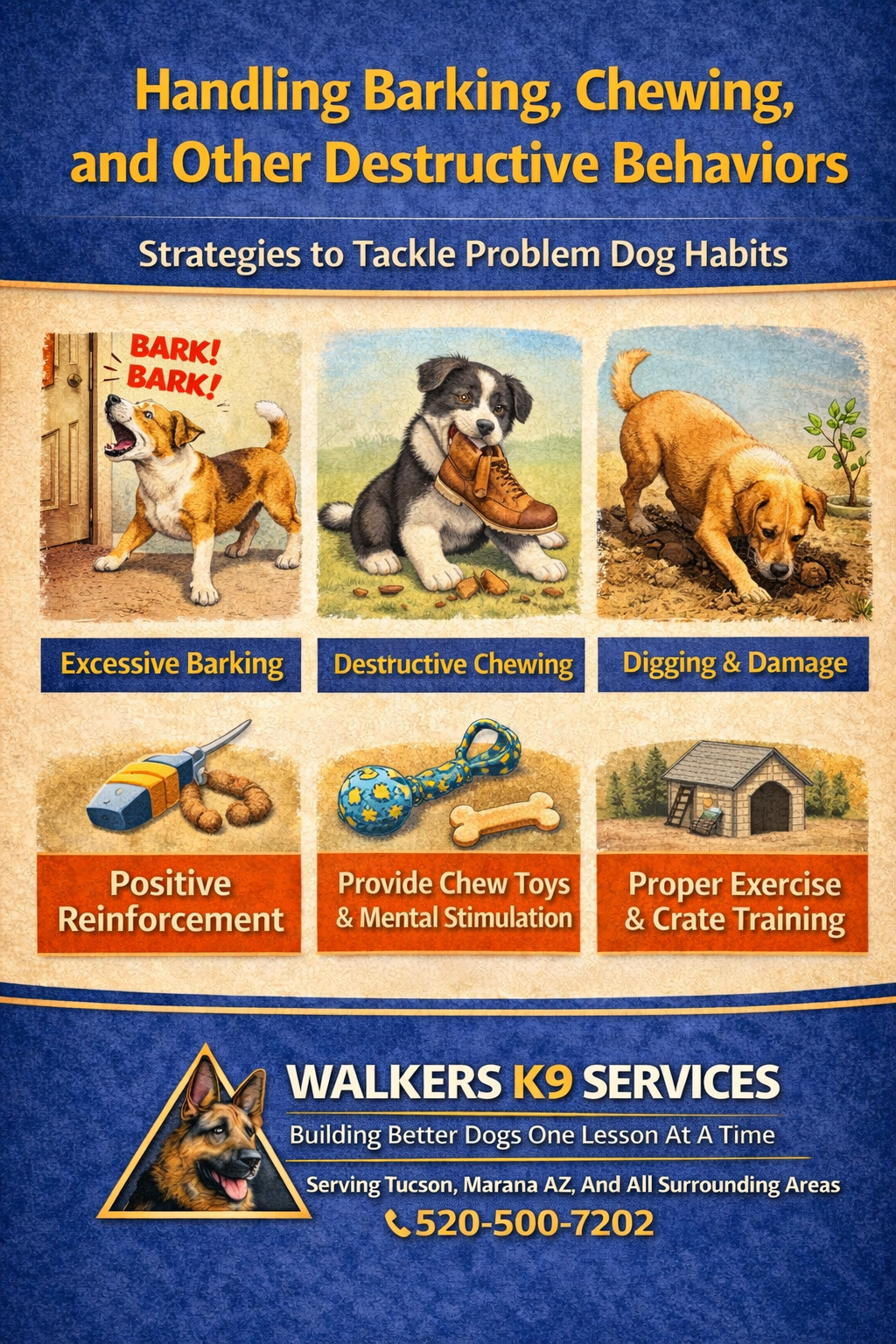
Handling Barking, Chewing, and Other Destructive Behaviors
By George Walker, Walker’s K9 Services – Tucson, AZ
Destructive behaviors like barking, chewing, digging, and general mayhem are some of the most common and frustrating issues dog owners face. The good news? These behaviors are almost always fixable once you understand why they happen and apply consistent training and structure.
This article breaks down the most common destructive behaviors, why they occur, and how to correct them effectively and fairly.
Why Dogs Develop Destructive Behaviors
Most problematic behaviors stem from one or more of the following:
1. Excess Energy or Lack of Exercise
A bored, under-stimulated dog will create its own entertainment — and you probably won’t like the results.
2. Anxiety or Stress
Separation anxiety, insecurity, or environmental stress can lead to barking, chewing, or pacing.
3. Lack of Structure or Clear Rules
If the dog never learned what is and isn’t allowed, it will make bad choices by default.
4. Attention-Seeking
Barking, whining, or misbehaving often works because owners accidentally reward it by reacting.
5. Normal Dog Behavior Without Proper Outlets
Chewing, digging, exploring, and alert barking are natural behaviors — they just need direction.
Handling Excessive Barking
1. Identify the Trigger
Is your dog barking at noises? People? Other dogs? Boredom? Anxiety? You can’t fix what you don’t understand.
2. Teach a “Quiet” Command
Start with:
Let the dog bark once or twice.
Say “Quiet.”
When the dog stops — even for one second — reward calmly.
Gradually build longer quiet periods before rewarding.
3. Avoid Accidentally Rewarding Barking
Yelling “NO!” or giving attention often reinforces the behavior. Calm, structured correction works better.
4. Provide Sufficient Exercise
Many barkers are under-exercised. A tired dog is a quiet dog.
5. Use Tools if Needed
For some dogs, a spray bottle, vibration collar, or remote collar (properly used) helps clarify the rule. Always pair tools with training, not frustration.
Handling Chewing
Chewing is one of the most natural behaviors in dogs — but it must be directed, not punished.
1. Management Is Key
If your dog can chew something valuable, it’s because the environment wasn’t secure.
Use gates, crates, and supervision until your dog proves trustworthy.
2. Rotate Appropriate Chew Toys
Offer safe, high-value items like:
Benebones
Nylabones
Kongs
Bully sticks (supervise always)
3. Redirect — Don’t Just Correct
If you see the dog chewing something inappropriate:
Say a firm “Eh-eh” or “No.”
Immediately offer the correct chew item.
Praise when they switch.
4. Exercise and Mental Stimulation
A mentally drained dog is far less likely to chew destructively. Add:
Obedience drills
Puzzle toys
Scent work
Fetch or tug sessions
5. Crate Training Solves 90% of Chewing
A properly crate-trained dog relaxes instead of looking for trouble.
Handling Digging
1. Address Excess Energy First
Digging is often boredom related.
2. Block Off Known Dig Zones
Use temporary fences, landscaping rocks, or supervision.
3. Provide a Legal Digging Area
A sandbox or dirt pit where digging is allowed gives the dog an outlet.
4. Interrupt and Redirect
Catch it early → say “No” → lead the dog to an appropriate toy or activity.
Handling General Destructive Behavior
1. Increase Structure
Dogs thrive with rules. Start with:
Scheduled walks
Scheduled feeding
Crate time
Training sessions
Clear boundaries (no counters, no jumping, no door rushing)
2. Build Calmness
Training is more than commands — it’s teaching your dog how to exist calmly.
Practice:
Place command
Down stays
Relaxation on leash
Quiet time in crate
3. Correct Fairly and Consistently
Correct the behavior the moment you see it. Don’t yell, don’t get emotional.
A calm correction is more effective than a loud one.
4. Reward Good Choices
Catch your dog being calm or making the right choice and acknowledge it.
Reinforce what you want rather than constantly reacting to what you don’t want.
When to Seek Professional Help
If the behavior involves:
Separation anxiety
Aggression
Extreme distress
Self-harm
Resource guarding
…contact a trainer immediately. These issues rarely improve without experienced guidance.
Final Thoughts
Destructive behaviors are not signs of a “bad dog.” They’re signs of a dog that needs structure, guidance, and an owner who will fulfill its mental and physical needs. With consistency and the right training approach, almost every destructive habit can be corrected.
Dog Training in Tucson, AZ Dog Training in Marana, AZ Training Options
Walkers K9 Services — Building Better Dogs, One Lesson at a Time
Please support our mission by sharing our training articles with other dog owners.
Written by: George Walker
Walkers K9 Services | Tucson, AZ
📞 520-500-7202