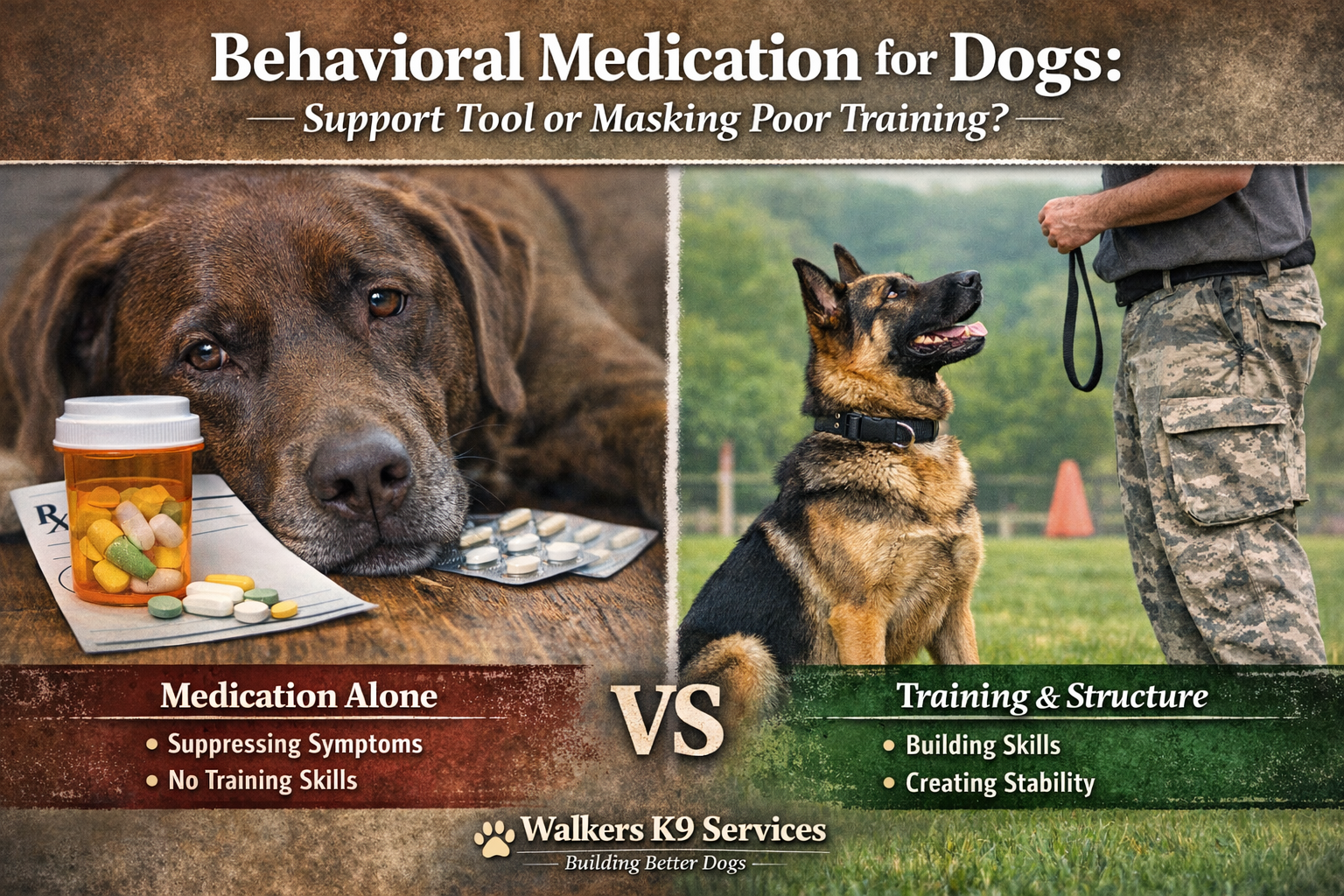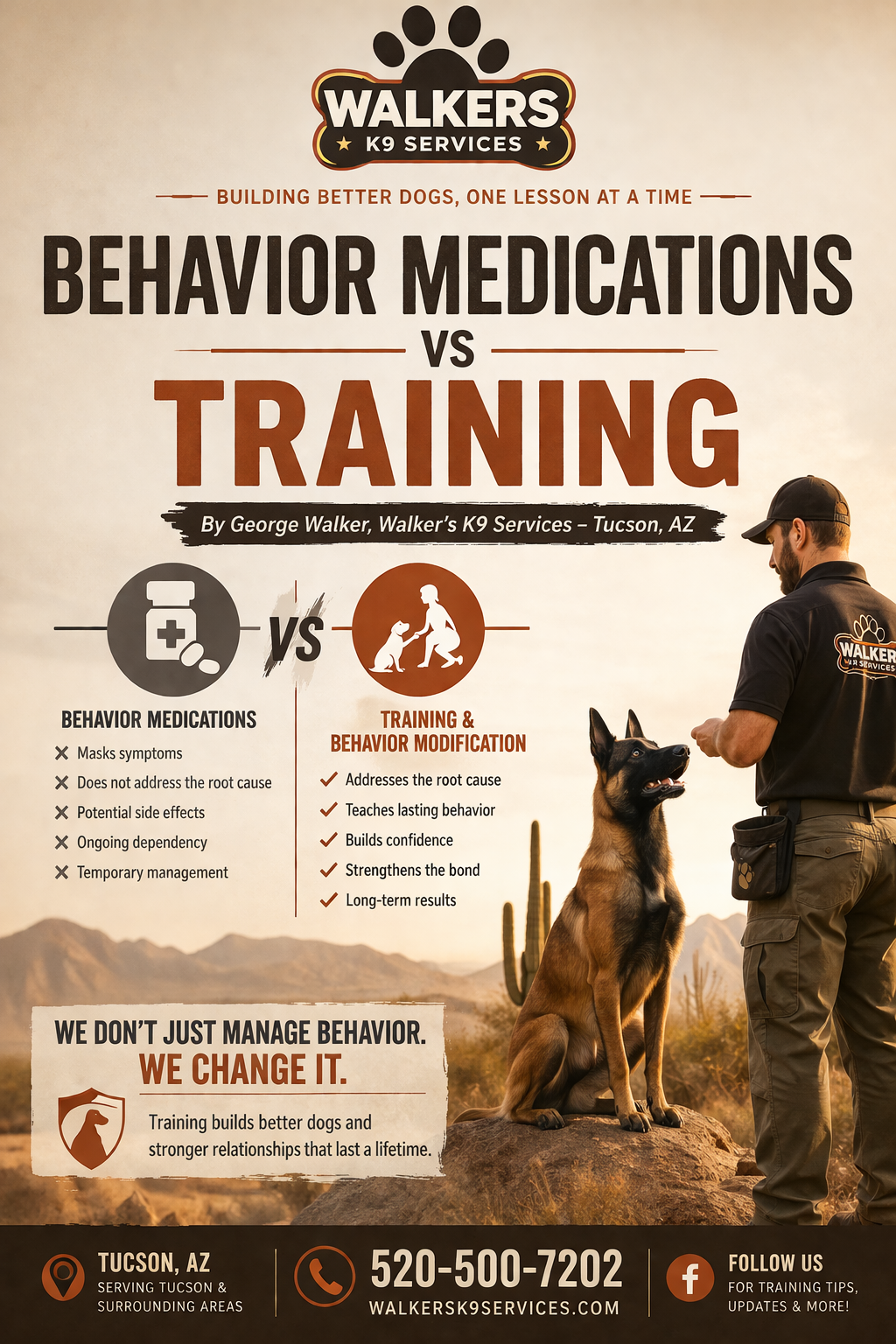
Behavioral Medication for Dogs
Helpful Support Tool or a Way to Mask Poor Training and Management?
By George Walker, Walker’s K9 Services – Tucson, AZ
Behavioral medication for dogs has become increasingly common over the past two decades. What was once considered a last-resort option for extreme cases is now often discussed early in a dog’s behavior journey—sometimes even before structured training or lifestyle changes are attempted.
For some dogs, behavioral medication can be an appropriate and humane support tool. For others, it becomes a convenient way to suppress symptoms without addressing the underlying cause of the behavior. This raises an important and often uncomfortable question for dog owners, trainers, and veterinarians alike:
Are we using medication to help dogs learn and cope—or to compensate for poor training, weak management, and human inconsistency?
The honest answer is that it can be either, depending entirely on how and why it is used.
This article explores the role of behavioral medication in dogs, the situations where it may be justified, the situations where it is often misused, and why training and management must always remain the foundation of behavior modification.
Understanding Canine Behavior Beyond the Label
One of the biggest challenges in modern dog behavior is the overuse of labels.
Terms like anxiety, reactivity, fear-based, and stress-related are often applied broadly, sometimes without a full evaluation of the dog’s lifestyle, structure, or training history. While true anxiety disorders absolutely exist in dogs, not every unwanted behavior stems from a chemical imbalance or psychological disorder.
Many behaviors commonly labeled as anxiety are actually learned responses reinforced over time.
Examples include:
A dog that panics when left alone but has never been taught independence
A dog that reacts aggressively on leash but lacks basic obedience and impulse control
A dog that cannot settle in the home because it has unlimited freedom and no routine
In these cases, medication does not address the cause—it simply dampens the expression.
What Behavioral Medications Are Actually Designed to Do
Behavioral medications are intended to influence the dog’s emotional state, not its training level.
Most commonly prescribed medications work by:
Reducing baseline anxiety
Dulling panic responses
Increasing emotional regulation
Lowering stress hormone activity
Improving impulse control at a neurological level
They do not:
Teach obedience
Build confidence through success
Create boundaries
Replace leadership
Teach coping skills
Medication does not tell a dog what to do. At best, it can help a dog become calm enough to learn what to do.
This distinction is critical.
Legitimate Scenarios Where Medication May Be Appropriate
There are dogs whose nervous systems are genuinely overwhelmed. These dogs are not simply “untrained” or “mismanaged.” They are emotionally flooded to a degree that prevents learning.
In these cases, medication may be appropriate as part of a broader plan.
Examples include:
Dogs with severe separation anxiety that results in self-injury
Dogs with panic responses to noise that cause complete shutdown
Dogs with compulsive behaviors that interfere with daily functioning
Dogs with trauma histories where stress recovery is extremely poor
These dogs often:
Cannot settle even with structure
Cannot process corrections or rewards
Escalate rapidly under mild pressure
Remain in a constant state of hypervigilance
Medication can reduce that baseline arousal enough to allow training to begin.
Importantly, medication should never be viewed as a cure—but as a bridge.
Medication as a Bridge, Not a Destination
When medication is used correctly, it serves one primary purpose: to create an opportunity for learning.
A well-structured plan includes:
Clear daily routines
Controlled exposure to stressors
Obedience training that builds confidence
Consistent rules and boundaries
Gradual skill development
In these cases, medication is often temporary or adjusted over time as the dog gains coping skills.
The ultimate goal should always be:
Improved emotional regulation through training
Reduced dependence on medication
Increased stability in real-world environments
If medication is used indefinitely without measurable training progress, something is missing.
When Medication Becomes a Substitute for Training
The misuse of behavioral medication is far more common than many people realize.
In modern dog culture, there is increasing pressure to:
Avoid correction
Avoid frustration
Avoid accountability
Avoid discomfort of any kind
This often leads to medication being prescribed or suggested before:
Basic obedience is taught
Daily structure is implemented
Exercise needs are met
Boundaries are established
A dog that has never been taught impulse control is not anxious—it is uneducated.
A dog that reacts on leash because it pulls everywhere is not fearful—it lacks leadership.
In these cases, medication becomes a way to quiet the behavior rather than fix the problem.
The Illusion of Progress
One of the most dangerous aspects of medication misuse is the illusion of improvement.
Owners often report:
“He seems calmer now”
“She doesn’t react as much”
“He’s easier to live with”
But calmer does not always mean healthier.
If the dog has not:
Learned new behaviors
Developed coping strategies
Responded reliably to obedience
Improved impulse control
Then the improvement is superficial.
Once medication is reduced, skipped, or stopped, the original behavior often returns—sometimes with greater intensity due to the lack of learned skills.
The Role of Training in Emotional Stability
Training is not just about commands—it is about clarity.
Dogs thrive when they understand:
What is expected of them
How to succeed
Where boundaries exist
How to respond under pressure
Structured training provides:
Predictability
Confidence through repetition
Emotional outlets
Mental engagement
A trained dog is often a calmer dog—not because it is medicated, but because it understands the world around it.
Training teaches dogs how to:
Self-regulate
Handle frustration
Recover from stress
Look to their handler for guidance
Medication cannot teach any of these skills.
Management: The Most Overlooked Factor
Even well-trained dogs can struggle if management is poor.
Management includes:
Limiting uncontrolled exposure
Using leashes and tools appropriately
Structuring the home environment
Preventing rehearsals of bad behavior
Setting realistic expectations
Many dogs labeled as “behavior cases” are simply overexposed and under-managed.
Medication will not fix chaos.
The Human Element Cannot Be Ignored
Behavioral issues in dogs are rarely just about the dog.
Owner behavior plays a massive role, including:
Inconsistency
Emotional reactions
Mixed signals
Poor follow-through
Lack of leadership confidence
Medication does not change human behavior.
If owners are unwilling to implement structure, training, and consistency, medication becomes a bandage applied to a moving target.
A Balanced, Responsible Approach
At Walkers K9 Services, we take a grounded, experience-based approach to behavioral challenges.
Our philosophy is simple:
Training and structure come first
Management supports training
Medication is considered only when necessary
Medication must support—not replace—training
Progress is measured by skill development, not suppression
We work to build dogs that can function confidently in the real world—not just appear calm at home.
The Long-Term Goal: Independence and Stability
The ultimate goal of any behavioral plan should be:
A dog that can cope without constant intervention
A dog that understands expectations
A dog that recovers from stress
A dog that does not rely solely on medication to function
For some dogs, medication may remain part of the picture. For many others, proper training eliminates the need entirely.
Both outcomes are acceptable when approached honestly and responsibly.
Walkers K9 Services Medication and Training Policy
At Walkers K9 Services, I require that any dog I work with be off all behavioral medications for a minimum of two weeks before training begins, unless there is a medical reason determined by a veterinarian that makes discontinuation unsafe. This policy is not about opposing medication; it is about accuracy. Behavioral medications can alter emotional responses, learning speed, stress thresholds, and feedback signals, making it difficult to assess a dog’s true behavior, temperament, and training needs. In order to design an effective and ethical training plan, I must see the dog’s natural responses, coping ability, and recovery under structure and guidance. Training built on a chemically altered baseline risks masking underlying issues rather than addressing them, which can lead to incomplete progress and long-term dependence. Starting with the dog off medication allows training, management, and leadership to be evaluated first—and only if necessary, medication can later be reintroduced as a support tool, not a substitute.
Final Thoughts
Behavioral medication for dogs is neither inherently good nor inherently bad. It is a tool—nothing more, nothing less.
When used thoughtfully, ethically, and alongside proper training and management, it can help some dogs reach a place where learning is possible. When used as a shortcut or substitute, it often delays real solutions and creates long-term dependency.
The most successful behavior outcomes always come from addressing the root cause—not just the symptoms.
Dogs deserve clarity, structure, and guidance. Medication may help some dogs get there—but training is what keeps them there.
Dog Training in Tucson, AZ Dog Training in Marana, AZ Training Options
Walkers K9 Services — Building Better Dogs, One Lesson at a Time 🔹
Please support our mission by sharing our training articles with other dog owners.
Written by: George Walker
Walkers K9 Services | Tucson & Marana, AZ
📞 520-500-7202
🌐 www.WalkersK9Services.org